

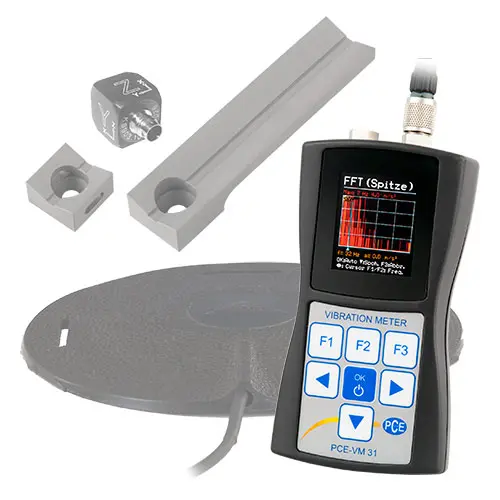



Human Vibration Meter with Hand-to-Hand and Full-Body Sensors, Model PCE-VM 31-HAWB
The PCE-VM 31-HAWB human vibration meter is designed to measure human vibration in the workplace. The vibration meter can calculate hand-arm vibration measurements in accordance with ISO 5349 and whole-body vibration measurements in accordance with ISO 2631. Each sensor consists of a three-axis vibration meter that records measurements of acceleration, velocity, and displacement. In addition to measuring human vibration, the Vibration Meter or Vibration Analyzer can measure machine vibration. The Vibration Analyzer also supports TEDS, which means it can automatically detect and identify TEDS-enabled sensors. In general, the device has 4 independent measurement channels. The measured data can be displayed as interval, running, or maximum RMS (MTVV), as well as the estimated vibration dose value (eVDV), vector sum, peak, and maximum. Acceleration can also be displayed as an FTT with up to 125 lines. The vibration analyzer’s internal flash memory can store up to 10,000 measurements or up to 1,000 FTTs, each with a date, time, and comment. Measured data can also be transferred to a computer via a USB 2.0 interface.
VAT is added to the calibration certificate—available upon separate request (not included in the set)
Highlights
– For three-axis measurement of hand-arm and whole-body vibration (Xh, Yh, and Zh axes) – For assessing the risk of hand-arm vibration syndrome (HAVS) and carpal tunnel syndrome
, measuring exposure action values (EAV) and exposure limit values (ELV), and to ensure regulatory compliance USB interface – Compact design – Easy to use – ISO 8041 calibration certificate options available (see accessories)
Technical Specifications
| Measurement Range | Sensor 1 mV/(m/s²) | Sensor 10 mV/(m/s²) |
| Acceleration | 1,100 m/s² / 3,609 ft/s² | 110 m/s² / 361 feet/s² |
| Speed | 100 mm/s … 10,000 mm/s 4.0 inches/s … 394.0 inches/s (1 kHz/1 Hz) |
10 mm/s … 1,000 mm/s 0.4 inches/s … 39.4 inches/s (1 kHz/1 Hz) |
| Displacement (peak) | 250 µm … 15,000 µm 0.01 inch … 0.6 inch (5 Hz/250 Hz) |
25 µm … 1,500 µm 0.001 inch … 0.06 inch (5 Hz/250 Hz) |
| Screen resolution (1/10 mV/(m/s²)) | ||
| Acceleration | 0.01 m/s² / 0.4 in/s² | |
| Speed | 0.1 mm/s / 0.004 inches/s | |
| Displacement | 1 µm / 4 × 10 ⁻⁵ inches | |
| Linearity range | > 75 dB ±6% error | |
| Noise | < 0.003 m/s² / 0.12 in/s² | |
| Inputs | 4 low-power IEPE inputs; 0.7 mA / 17 V; TEDS support, IEEE 1451.4, Model 25 | |
| Sensor sensitivity | 0.8–120 mV/(m/s²) | |
| Display units for human vibration (acceleration) |
Interval RMS vector sum max. operating RMS (MTVV) vibration dose value (VDV) |
|
| Displays units for acceleration, velocity, and displacement | Operates in RMS mode , maximum RMS , vector sum , peak value , maximum peak value |
|
| Filters | Weighting Filters: Wb, Wc, Wd, Wh, Wj, Wk, Wm | |
| Unweighted: 6.3–1259 Hz (H/A) / 0.4–100 Hz (G/K) | ||
| Acceleration: 0.1–2000 Hz / 1–1000 Hz | ||
| Frequency: 1–100 Hz / 2–1000 Hz / 10–1000 Hz | ||
| Frequency range: 5–250 Hz | ||
| Frequency Analysis (FFT) | 125 lines for X/Y/Z, peak acceleration spectrum, 3–240/6–480/12–960/24–1920 Hz | |
| Data Memory | Flashlight, 10,000 measurements, 1,000 FFts, each with date, time, and comment | |
| Display | OLED, 128 x 160 pixels, color | |
| Interface | USB 2.0, full speed, CDC mode (virtual COM port), via VM2x-USB cable | |
| Batteries | 3 x 1.5 V AAA batteries or rechargeable batteries (LR03 or HR03) | |
| Environmental Conditions | -20 °C … +60 °C / -4 °F … +140 °F < 95% RH |
|
| Approx. dimensions | 125 mm x 65 mm x 27 mm 4.9 x 2.6 x 1.1 inches (without plugs) |
|
| approx. weight | 140 g / 0.31 pounds | |
1 x PCE-VM 31-HAWB Human Vibration Meter
1 x Hand-to-Hand Accelerometer KS903.10
1 x Full-body acceleration sensor KB103SVD
1 x Handheld adapter for curved surfaces 142
1 x Handle adapter for curved surfaces 140 1 x Handle adapter for curved surfaces 140 1 x 3 x USB cable 9 (
3 1 ft / 3 ft) cable. x Batteries 1 x User manual 1 x Carrying case