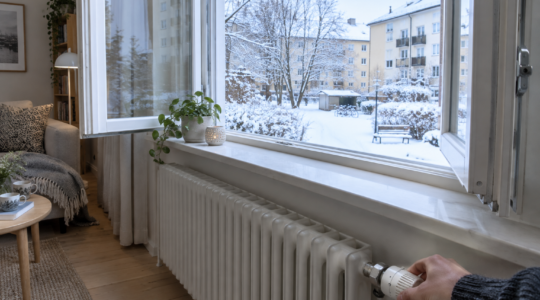


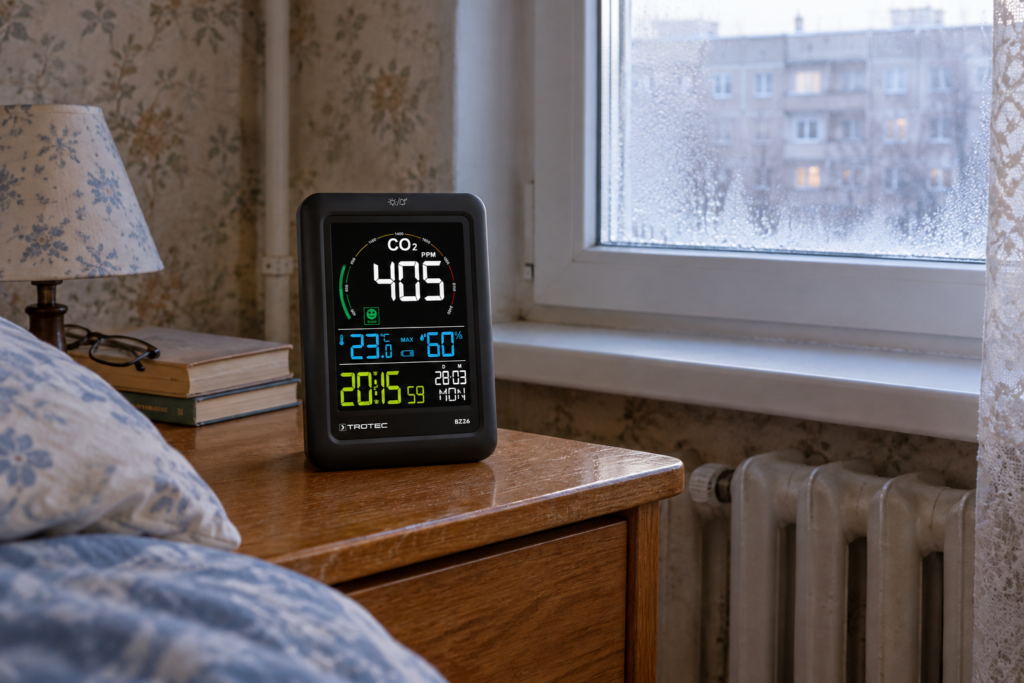
If you live in an apartment built before 1990, your home almost certainly relies on natural exhaust ventilation. In these systems, warm, stale air exits through passive grilles in the kitchen and bathroom into a central vertical shaft, while fresh outdoor air infiltrates through micro-gaps around traditional wooden window frames and the building envelope.
When those drafty original windows are replaced with modern, airtight PVC units, that natural airflow path disappears. Air exchange rates plummet overnight. That is why fixing a stuffy apartment doesn’t start with buying the first appliance you see—it begins with measuring your actual air quality and deliberately restoring a route for fresh air to enter.
Follow these steps in order:
- Monitor overnight bedroom CO₂ and relative humidity levels
- Inspect and thoroughly clean kitchen and bathroom exhaust grilles
- Establish dedicated fresh air inlets using window trickle vents or through-wall vents
- Maintain an adequate undercut beneath interior doors
- Install a decentralized heat recovery ventilator (recuperator) in problematic rooms
- Coordinate whole-building ventilation upgrades through your apartment association
| What you notice | Likely cause | First step |
|---|---|---|
| Waking up with a headache or heavy, stuffy air | Insufficient supply air | Measure CO₂ levels; install a fresh air vent |
| Window condensation, mold in exterior corners | Trapped indoor moisture | Inspect bathroom and kitchen exhaust draft |
| Neighboring cooking odors entering your living space | Pressure imbalances in the shared shaft | Disconnect any motorized range hood from the shaft; notify the apartment association |
| Stagnant, heavy air during summer | Collapsed natural draft (thermal buoyancy loss) | Install a decentralized recuperator or set up cross-ventilation |
How to Tell If Your Ventilation Isn’t Working
The single most objective way to assess ventilation is with a carbon dioxide (CO₂) monitor. Because we exhale CO₂ with every breath, indoor levels serve as a real-time proxy for fresh air delivery. Under Estonian building design standards, indoor concentrations below 1,000 ppm indicate good air quality (ambient outdoor air sits around 400 ppm). Between 1,000 and 2,000 ppm, occupants typically begin to feel sluggish and lose concentration. Above 2,000 ppm, air quality degrades enough to cause headaches, fatigue, and restless sleep.
Older multi-family housing routinely breaches these thresholds. In a study of 189 apartments conducted by Tallinn University of Technology (TalTech), the average CO₂ concentration in naturally ventilated apartments was 1,225 ppm, compared to 788 ppm in modern buildings equipped with mechanical ventilation. In bedrooms, morning concentrations regularly spiked between 1,000 and 4,200 ppm—with the highest readings recorded in rooms fitted with new airtight windows where interior doors stayed shut overnight.
Relative humidity is just as critical. According to the Health Board, the recommended indoor relative humidity is 35–60%. What matters most, however, is not just the reading in the middle of the room, but the microclimate against cold exterior surfaces. When relative humidity at a cold wall surface or window reveal exceeds 80%, mold spores begin to germinate. That is why mold almost always takes hold first along outer corners, window edges, and behind bulky wardrobes.
You can perform a quick draft check with a sheet of paper. Hold a lightweight sheet up to the exhaust grille: if it does not hold itself in place against the grille—even when a window is slightly cracked open—the shaft draft is too weak or the duct is blocked. While this test shows the direction of airflow, it cannot measure volume. Any serious decisions should rely on actual monitored data.
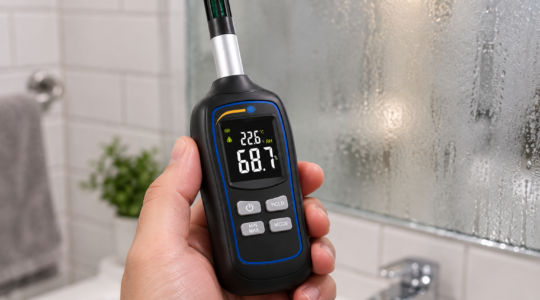
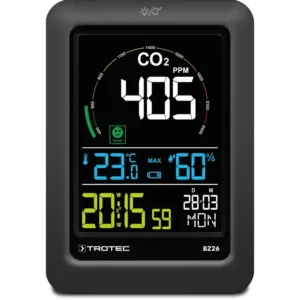
A compact desktop monitor that logs CO₂, temperature, and relative humidity is ideal for home diagnostics. Place it on a nightstand near your bed and review peak morning readings. Pro Air’s range of temperature and humidity meters features everything from simple home displays to advanced data loggers. The Trotec BZ26, for example, measures CO₂ from 400 to 5,000 ppm alongside real-time relative humidity and temperature.
Why Natural Ventilation Fails in Older Buildings
Natural ventilation operates entirely on the stack effect. Because warm indoor air is lighter than cold outdoor air, it rises up the vertical exhaust shaft, creating negative pressure that pulls fresh air in through gaps in the building facade. The colder the weather outside—and the taller the shaft—the stronger the draft. During spring and summer, when outdoor temperatures climb to match indoor levels, this buoyancy force vanishes completely, and airflow can even reverse.
Even in winter, natural air exchange in older apartment blocks falls significantly short of modern standards. TalTech research revealed that the average air exchange rate in older apartment buildings was just 0.24 air changes per hour. In other words, it takes roughly four hours to replace the air inside the apartment. Expressed per unit of floor area, that works out to 0.17 l/(s·m²)—less than half of the 0.42 l/(s·m²) baseline mandated by standard EVS-EN 16798-1. Installing modern windows without adding supplementary vents cuts natural air exchange by roughly two-thirds.
Building height also plays a decisive role. In 5- and 6-story blocks, each apartment typically has an independent exhaust duct running to the roof. In 9-story or taller buildings, individual ducts are usually reserved for the top two floors, while lower floors tie into a common collector shaft. Paradoxically, top-floor apartments suffer the most: because their duct run to the roof is so short, natural draft is virtually non-existent.
Practical Steps You Can Take in Your Apartment
Clean Exhaust Grilles and Keep Them Unobstructed
Kitchen and bathroom grilles collect thick layers of dust and kitchen grease over time, severely constricting air passage. Remove the grilles, wash them thoroughly in warm soapy water, and vacuum out the duct opening as far back as you can reach. Never seal an exhaust vent or block it with kitchen cabinetry, even if you feel cold air settling near it in the dead of winter.
For reference, the national “Kodud korda” (Homes in Order) housing renovation guidelines target an exhaust flow rate of 15 l/s combined for the bathroom and toilet, and 8 l/s for the kitchen in a standard two-room apartment. If cleaning the grilles does not restore adequate draft, contact your apartment association. Ventilation shafts are shared property, and keeping them clear of blockages and bird nests is the association’s legal responsibility.
Provide a Path for Fresh Air to Enter
Exhaust vents cannot pull air out if no fresh air can get in. The quickest, least invasive solution is a window trickle vent installed into the upper frame or sash, which requires no structural core drilling. Another robust option is a through-wall fresh air vent. Positioning a wall vent directly above or behind a radiator allows cold incoming air to mix with rising heat plumes before circulating through the room, eliminating uncomfortable cold drafts at floor level.
Ensure the top edge of any wall vent sits at least 10 cm below the ceiling. Keep in mind that core-drilling an exterior wall penetrates the building envelope, which is shared common property; you must secure formal permission from your apartment association before starting work.
Maintain an Air Gap Under Interior Doors
In a natural ventilation layout, air flows from bedrooms and living spaces toward the wet-room exhaust points in the bathroom and kitchen. When bedroom doors close tightly against weatherstripped thresholds, that circuit is severed. Closed bedrooms invariably record the worst CO₂ spikes in the home. Ensure every interior door has an undercut clearance of at least 0.5 cm, or install an acoustic door transfer grille to allow air to pass freely without sacrificing privacy.
A Common Mistake: Connecting a Motorized Range Hood to a Shared Shaft
Hooking a high-powered kitchen range hood or an in-line bathroom fan directly into a natural gravity shaft is one of the most common—and disruptive—mistakes apartment owners make. In a shared duct system, a motorized fan pressurizes the shaft, forcing your cooking fumes and grease straight into your neighbors’ apartments while choking off their natural upward draft. The Estonian Union of Co-operative Housing Associations (EKÜL) frequently highlights that these unilateral modifications ruin the indoor climate for the entire building column.
Modifying common building infrastructure requires approval from the housing association, along with a formal design project and a building notice. If your kitchen does not have a dedicated duct discharging straight through an exterior wall, use a recirculating range hood equipped with an activated carbon filter. It will trap grease and neutralize cooking smells without disrupting shaft pressure—though because it does not vent moisture, your natural exhaust grille must remain open and operational.
Decentralized Recuperators: When Are They the Right Solution?
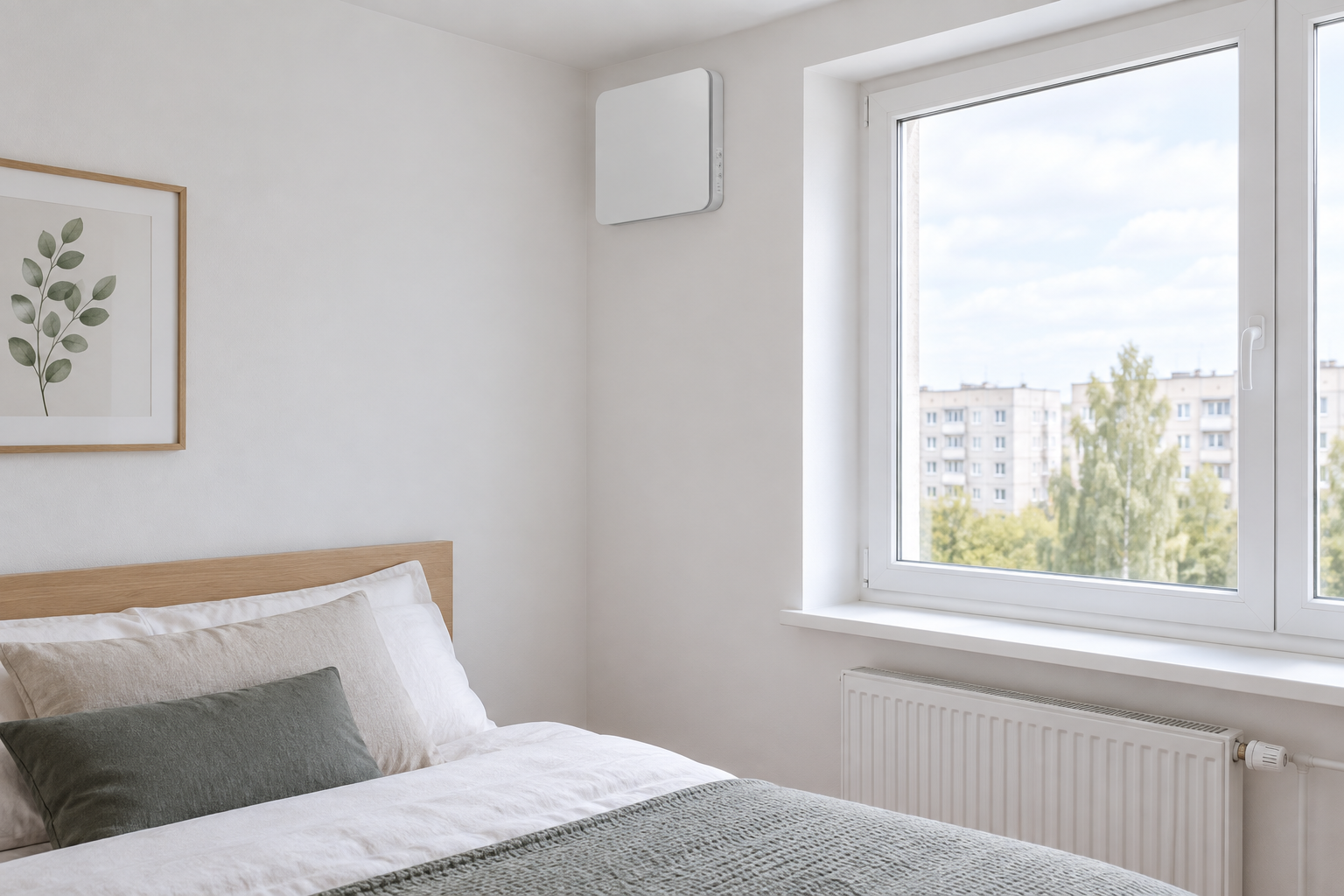
If bedroom CO₂ levels stay stubbornly above 1,000 ppm despite adding passive vents, or if cold drafts from wall vents make winter living uncomfortable, a decentralized recuperator (a single-room heat recovery unit) is the logical upgrade. Installed directly through an exterior wall, the unit contains a regenerative ceramic heat exchanger that absorbs heat from outgoing stale air and transfers it to incoming fresh air. The internal fan alternates direction cyclically—for example, the BSK Zephyr Mini reverses every 70 seconds. For optimal pressure balance and continuous air exchange, decentralized units work best in synchronized pairs: while one unit brings in fresh, pre-warmed air, the other exhausts stale air.
Sizing Example: A 12 m² Bedroom for Two Occupants
According to standard EVS-EN 16798-1, standard indoor environmental quality (Category II) requires a fresh air supply of 7 l/s per person. For two people, that means 14 l/s (roughly 50 m³/h). REHVA guidelines similarly recommend at least 12 l/s for a typical 11–15 m² bedroom.
Here is an essential engineering consideration: an alternating, single-duct recuperator supplies fresh air only 50% of the time (spending the other half of the cycle exhausting air). Therefore, a unit with a nominal top speed of 25 m³/h delivers an effective fresh air supply of only around 12 m³/h. A synchronized pair of these units supplies an effective 25 m³/h (7 l/s). While that is plenty for a single sleeper, it falls short of Category II standards for two people, bordering on Category III comfort. For a double bedroom, it is far better to install a synchronized pair rated at 50–60 m³/h and run them at medium speed. This setup satisfies the airflow demand while keeping fan noise whisper-quiet.
Pro Air’s curated catalog of decentralized recuperators includes several field-tested options:
- Blauberg VENTO inHOME W: 25 m³/h in heat recovery mode, up to 95% thermal efficiency, and an operating noise level of just 27 dB(A) at 3 meters
- Ideal Clima KERS+25: Airflow up to 25 m³/h, up to 97% heat recovery efficiency, under 29 dB at 3 meters, and a compact 102 mm wall core
- BSK Zephyr Mini: Four operating speeds spanning 8 to 30 m³/h and up to 90% thermal efficiency
Decentralized units are ideal for targeted intervention in bedrooms and home offices that lack active fresh air paths. However, they are not a silver bullet for the whole apartment. REHVA field studies note that overall air exchange in renovated apartments relying exclusively on single-room decentralized units averaged just 0.18 air changes per hour. Light sleepers should also account for low-level mechanical fan noise during quiet night hours.
-
 Available
BSK Zephyr Mini 100 mm 30 m³/h – Single-Room Heat Recovery Ventilator, 100 mm
277 €
-
-7%
 Available
Ideal Clima Kers+25 Ultra-Quiet Heat Recovery Ventilator – Fresh Air with Low Energy Consumption
Original price was: 321 €.298 €Current price is: 298 €.
-
 Available
Top-of-the-Line Blauberg VENTO inHOME W 50 m³/h Wi-Fi Heat Recovery Ventilator
369 €
When Apartment-Level Fixes Are Not Enough
When chronic damp and mold affect multiple apartments, cooking odors drift between floors, or CO₂ readings refuse to budge, the problem lies in the building’s central infrastructure. At that point, individual measures can only do so much; the real solution is a centralized, building-wide overhaul. Under the criteria for the EIS “Kodud korda” grant, full apartment building retrofits must install heat recovery ventilation serving all habitable rooms or an exhaust air heat pump system. Depending on location, grant funding rounds have covered 30–50% of total renovation costs. Be sure to check the latest terms on the EIS portal before bringing the matter to your building’s general meeting.
If your association is not yet ready to finance a major capital project, decentralized recuperators remain the most reliable way to protect your personal living environment. For a closer look at the long-term trade-offs between both strategies, consult our guide to decentralized vs. centralized ventilation. If you want clear, objective evidence before investing, Pro Air also provides professional indoor air quality audits to accurately record CO₂ swings, humidity dynamics, and fine particulate levels.
Always follow the logical progression: measure baseline air quality first, clean and verify exhaust paths, ensure fresh supply air can enter, and only then invest in mechanical solutions properly sized to your room’s occupancy.
Frequently Asked Questions
Only if your apartment association has explicitly authorized it and the building shaft is engineered to handle mechanical exhaust. In a shared gravity shaft, a mechanical fan alters internal duct pressure, disrupting ventilation and forcing stale air or odors into neighboring homes.
Brief cross-ventilation exchanges stale air quickly, but indoor CO₂ levels begin climbing again the moment windows are closed at night. Leaving windows cracked continuously throughout winter leads to major heat losses and cold drafts. Window trickle vents or a decentralized recuperator provide continuous, controlled air exchange without draft discomfort.
Yes. In accordance with Estonian Supreme Court precedent, exterior building walls constitute co-owned common property, meaning any core drilling through the facade alters common elements. Under the Apartment Ownership and Apartment Associations Act, this work requires formal consent from the co-owners.