

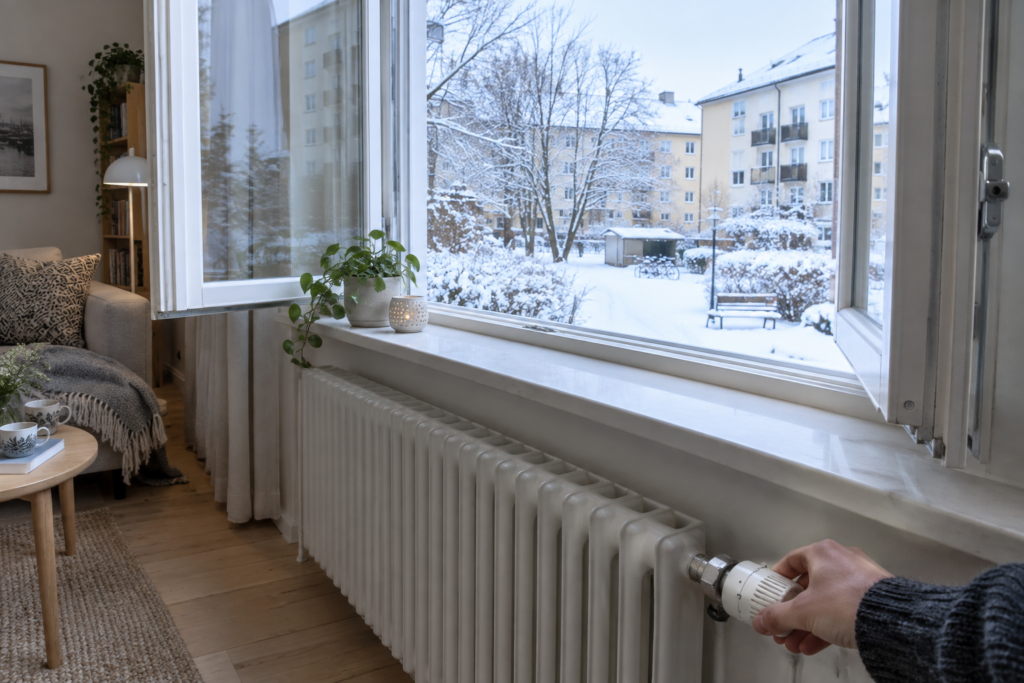
Winter ventilation should be swift and decisive: fling your windows wide for 3 to 10 minutes, ideally creating a cross-breeze across opposite sides of the home, three to four times a day. Always turn down your radiator thermostats before opening windows, and dial them back up once you close them. Counterintuitively, the colder it is outside, the less time you need—a sharp difference between indoor and outdoor temperatures drives exceptionally rapid air exchange. Whatever you do, avoid leaving windows cracked open or tilted for hours. That habit merely leeches heat from your walls, sends heating bills soaring, and barely makes a dent in indoor humidity.
Quick checklist:
- Duration: 3–5 minutes when it is below 0 °C; up to 10 minutes between 0 °C and 10 °C.
- Frequency: Morning and evening at a minimum; ideally 3–4 times daily, and immediately after showering, cooking, or drying clothes inside.
- Targets: Carbon dioxide below 1,000 ppm and indoor relative humidity between 35% and 45%.
- What to avoid: Leaving windows tilted open for hours on end, and letting radiators blast heat while windows stand open.
Why Winter Ventilation Works So Well
Homeowners often worry that opening windows in sub-zero weather invites damp, frigid air into their living space. In reality, winter provides the best conditions of the year for effective ventilation. Frigid outdoor air holds negligible moisture: at −10 °C, air saturated at 100% capacity carries only about 2.4 g of water vapour per cubic metre, compared to 17.2 g at 20 °C.
When that −10 °C air (even at 80% relative humidity) enters your home and warms up to 20 °C, its relative humidity plummets to roughly 11%. Each cubic metre of warm 20 °C indoor air at 50% relative humidity that you purge carries roughly 6.7 g of moisture out with it.
To put this into perspective, a standard 50 m² apartment with 2.5 m ceilings holds about 125 m³ of air. A single complete air exchange at −10 °C extracts about 0.8 litres of moisture. According to Building Performance New Zealand, drying just one load of laundry indoors introduces roughly 5 litres of moisture into the air, while a single shower contributes about 1.5 litres. Evaporating and expelling the moisture from that single load of laundry requires almost six full air replacements.
Around the freezing mark, this dehumidifying effect diminishes considerably. At 0 °C and 80% humidity, outside air holds around 3.9 g of water per cubic metre, meaning every exchanged cubic metre removes only about 4.7 g. As a result, mild, damp thaws—not sub-zero cold snaps—present the greatest challenge for managing indoor humidity during northern winters.
How Long and How Often to Ventilate in Winter
How long you should air out a room comes down almost entirely to outdoor temperatures. A steep temperature gradient generates powerful convective currents that can replace an entire room’s air volume in just a few minutes. The German Environment Agency recommends ventilating for 5–10 minutes with windows opened wide. Similarly, the German Window and Facade Association suggests 5 minutes in freezing weather, extending to 10 minutes when temperatures sit between 0 °C and 10 °C.
| Outdoor Temperature | Airing Duration | Why |
|---|---|---|
| Below −10 °C | 3–5 minutes | Air exchanges extremely fast; longer airing only chills structural surfaces and furniture |
| −10 °C to 0 °C | Around 5 minutes | Typical winter baseline |
| 0 °C to +10 °C | Up to 10 minutes | Narrower temperature difference; slower air exchange |
For frequency, German consumer advocacy group Verbraucherzentrale advises airing your home out at least 3 to 4 times a day for basic indoor hygiene. The more people residing under your roof—and the more active they are—the more often windows need to open. The morning airing cycle is especially critical, as both water vapour and carbon dioxide build up in bedrooms overnight.
In Estonia, a revealing case study conducted by the National Heritage Board examined an apartment building relying entirely on natural ventilation. At −15 °C, residents did not need to open windows at all, even in densely occupied units, because the massive indoor-outdoor temperature gap created a potent natural stack effect. At 0 °C, additional window ventilation became necessary as occupancy rose. By +10 °C, keeping indoor air fresh required windows to remain tilted almost around the clock. While these observations reflect a single building, the physical principle is universal: the milder the winter weather, the more actively you must ventilate.
Step-by-Step Guide to Proper Winter Ventilation
- Turn down radiator thermostats first. If cold air hits an active thermostatic valve, it opens fully, sending expensive radiator heat straight out into the yard.
- Open windows all the way. Create a cross-draught wherever possible by opening windows on opposite sides of the building and propping interior doors open. This purges stale air in the shortest possible time.
- Stick strictly to the recommended timeframe. Brief “shock ventilation” replaces the air without chilling walls, floors, or furniture, allowing the room to rebound to a comfortable temperature within minutes of closing the windows.
- Shut the windows and reset your thermostats. This final step is the most frequently overlooked, often leaving rooms shivering by morning.
- Target moisture at the source. After showering, cooking, or hanging washing, shut the door to that specific room and open its window immediately. This confines moisture to one area and purges it before it can migrate through the rest of the home.
Airing your home is far simpler when you produce less ambient moisture to begin with. Always cover pots with lids when boiling water; an uncovered pot releases around 100 g of moisture every 10 minutes. Run your kitchen extractor hood from the moment cooking begins, and keep your bathroom extractor fan running for 10 to 15 minutes after stepping out of the shower. Exhausting steam at the source prevents moisture from drifting into adjacent rooms and condensing against cold exterior walls and window panes.
Common Winter Ventilation Mistakes
Leaving windows tilted open for hours. According to the German Environment Agency, keeping windows tilted open causes heating bills to spike while doing very little to flush out stale air. The window reveals and surrounding masonry cool down severely, creating prime conditions for condensation and toxic black mould. If you prefer a cooler bedroom for sleeping, lower the radiator thermostat instead.
Underheating rooms to save on fuel. The German Environment Agency also cautions against letting temperatures in occupied rooms drop below 16–18 °C, as cooler structural surfaces attract condensation and mould. Because cool air holds less moisture before reaching saturation, colder rooms actually require more frequent airing, not less.
Sealing off natural ventilation grilles. Many older apartment buildings rely on passive ventilation shafts in kitchens and bathrooms. When drafty original windows are swapped for airtight double- or triple-glazed units without upgrading the ventilation system, air exchange collapses entirely. A doctoral thesis from Tallinn University of Technology (TalTech) revealed that two-thirds of apartments in unrenovated buildings suffer from inadequate air exchange. In such settings, opening windows manually cannot compensate for an inoperative passive stack system.
Relying on your senses. Humans adapt quickly to declining air quality; what feels perfectly normal after spending an hour in a room may actually be severely depleted air. Environmental sensors provide objective, actionable data that intuition cannot match.
Measure, Don’t Guess: CO₂ and Humidity
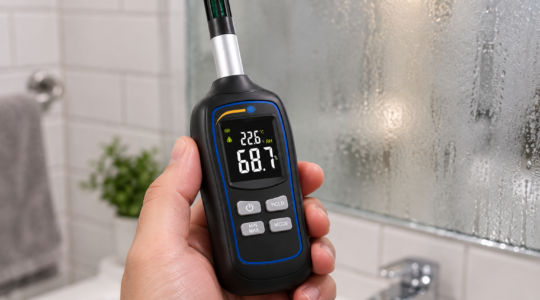
The Health Board recommends maintaining indoor relative humidity between 35% and 60%. During the winter heating season, however, you should aim for the lower end of that spectrum. Nordic building research suggests that 25–45% is ideal in winter; the TalTech thesis notes that sustained humidity levels between 40% and 60% in winter frequently lead to structural moisture damage. If relative humidity consistently stays above 60% and windows fog up every morning, step up your airing schedule. If readings drop below 30%, shorten your airing intervals rather than eliminating them—learn more about why indoor air becomes dry during the heating season and how to manage it.
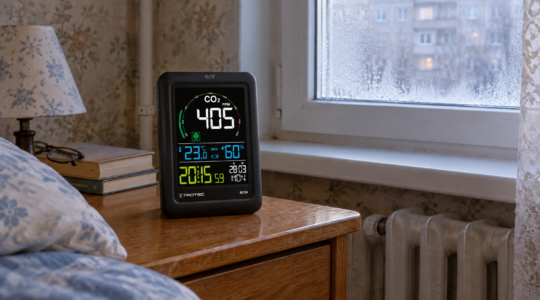
Carbon dioxide serves as the most reliable proxy for overall air freshness. Fresh outdoor air contains roughly 400 ppm of CO₂, while a well-ventilated indoor space generally hovers between 600 and 800 ppm. Once CO₂ levels climb significantly above 1,000 ppm, rooms need airing out. In an experiment by the Technical University of Denmark, CO₂ levels in a bedroom with closed windows averaged 2,585 ppm overnight, compared to just 660 ppm when ventilated. Keeping CO₂ levels low led to measurable gains in sleep quality and next-day cognitive performance.
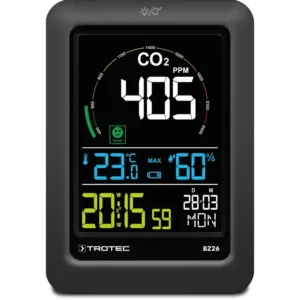
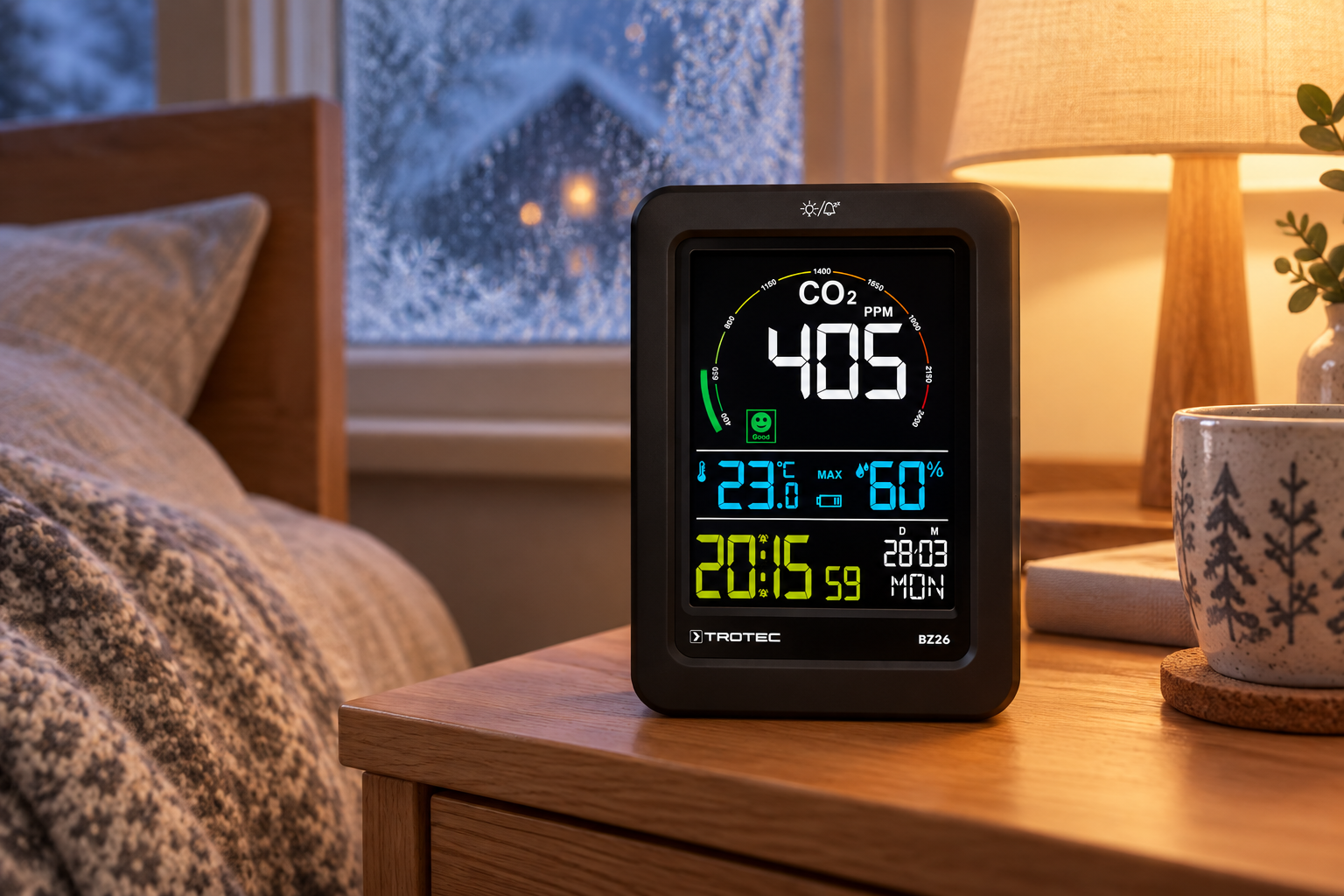
An indoor air monitor eliminates the guesswork. Position one in your bedroom and check the reading upon waking: if it exceeds 1,000 ppm, leave the bedroom door ajar at night or look into continuous mechanical solutions. You can explore suitable options in our temperature and humidity monitors selection. The Trotec BZ26 tracks CO₂, temperature, and relative humidity simultaneously. For a broader overview of air quality, the Hale Air Sense also tracks volatile organic compounds (VOCs) and fine particulate matter.

When Opening Windows Isn’t Enough
Opening windows works well when someone is home to manage the schedule. In many daily situations, however, manual ventilation falls short. If you are away at work all day, live along a loud arterial road, or wake up to bedroom CO₂ levels consistently topping 1,000 ppm, your living space needs automated, continuous air exchange.
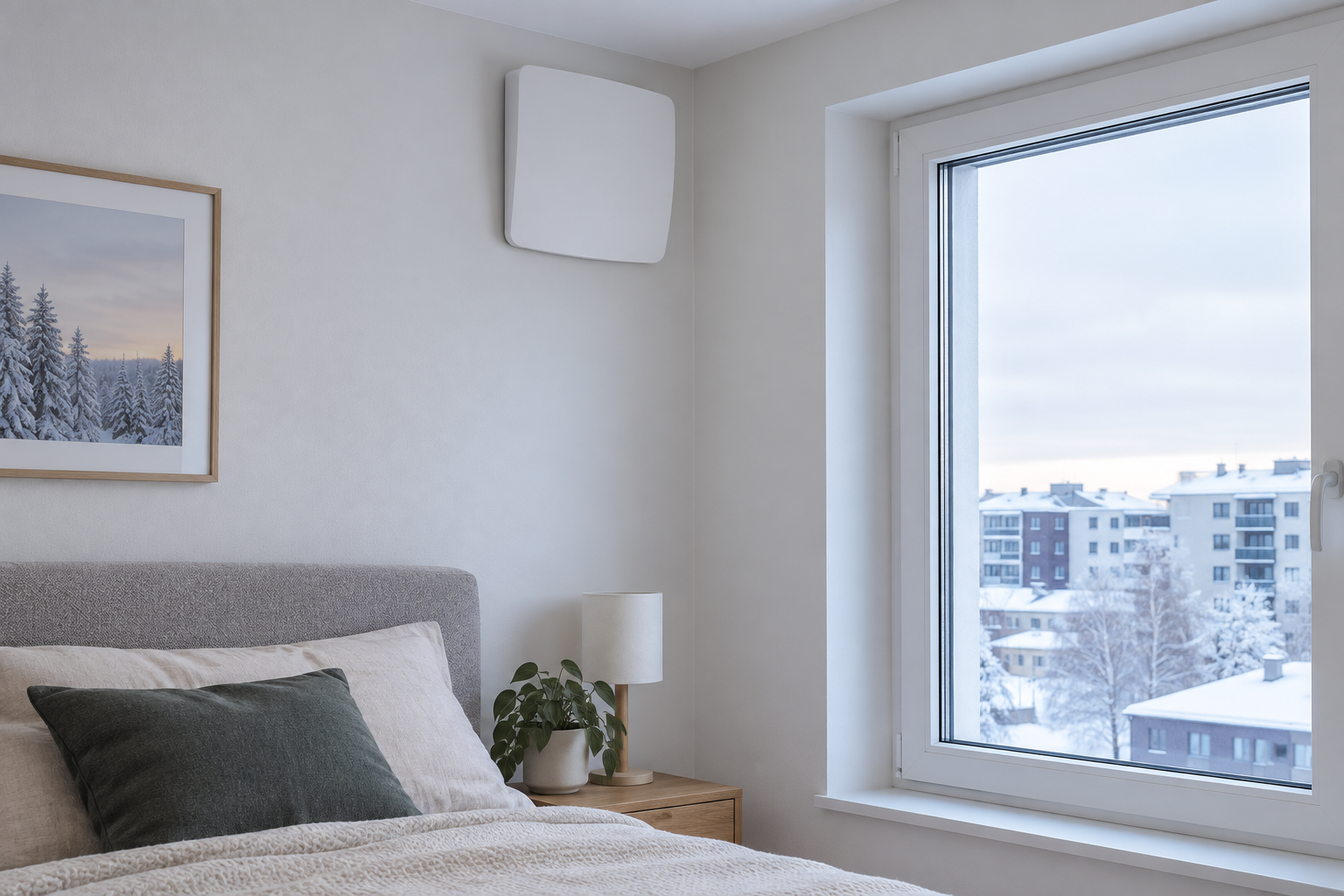
In flats where retrofitting ducted central ventilation is impractical, single-room decentralised heat recovery units provide the ideal workaround. Installed through a core-drilled hole in an exterior wall, these units introduce filtered fresh air, exhaust stale indoor air, and use a ceramic regenerator core to capture heat from outgoing air and warm incoming air. This ensures a steady supply of pre-warmed fresh air without draughts or excessive heat loss, even during −20 °C cold snaps.
When selecting a unit, size it according to the room’s volume:
- The BSK Zephyr Mini delivers an airflow rate of up to 30 m³/h, making it ideal for compact bedrooms.
- The Ideal Clima Kers+60 moves up to 60 m³/h, achieves up to 94% thermal efficiency, and runs whisper-quiet—ideal for living rooms and master suites.
- The Blauberg VENTO inHOME W (up to 50 m³/h) features integrated Wi-Fi for smartphone control.
Browse the full lineup on our single-room heat recovery units page.
-
 Available
BSK Zephyr Mini 100 mm 30 m³/h – Single-Room Heat Recovery Ventilator, 100 mm
277 €
-
-10%
 Available
Ideal Clima Kers+60 Ultra-Quiet Heat Recovery Ventilator – Effective Ventilation Up to 60 m³/h
Original price was: 341 €.308 €Current price is: 308 €.
-
 Available
Top-of-the-Line Blauberg VENTO inHOME W 50 m³/h Wi-Fi Heat Recovery Ventilator
369 €
Keep the practical aspects of installation in mind. Decentralised units require a core-drilled opening through an external wall, a dedicated power supply, and routine filter cleaning or replacement. In multi-family apartment buildings, drilling through an exterior facade typically requires approval from the housing association or property management. If your building already features a balanced central ventilation system, an add-on unit is generally unnecessary; a duct clean, system rebalancing, or fresh set of filters will usually solve the problem. If you are uncertain which system suits your layout, the specialists at Pro Air can evaluate your property and manage the installation from start to finish.
The fundamental rule of winter ventilation remains simple: open windows wide for short bursts several times a day, and always turn down the radiators first. When real-time sensor data proves that manual airing still leaves your air heavy or stale, it is time to invest in continuous mechanical ventilation.
Frequently Asked Questions
Leaving a window tilted open all night cools down the window reveal and adjacent masonry, promoting condensation and mould growth while driving up your heating consumption. A far better strategy is to air the room thoroughly with the window wide open for 5 minutes right before sleeping, then leave the bedroom door open to allow air circulation. If morning CO₂ readings still exceed 1,000 ppm, install a decentralised heat recovery unit.
Cold outdoor air holds very little moisture, so warming it up indoors drops relative humidity significantly. Every ventilation cycle lowers indoor humidity. If relative humidity drops below 30%, shorten your airing intervals to 2 to 3 minutes rather than skipping them, as stopping ventilation causes carbon dioxide and pollutants to accumulate.
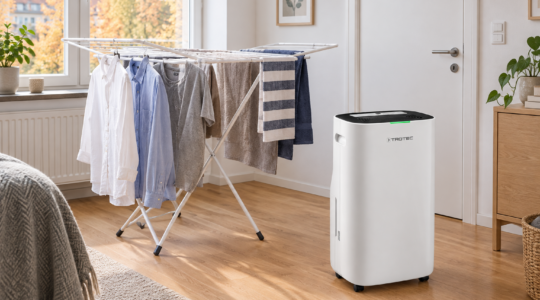
An empty home generates virtually no fresh moisture or carbon dioxide, so airing out once before leaving in the morning and once upon returning in the evening is usually sufficient. However, if you leave laundry drying on a clothes airer indoors while you are out, air the home out thoroughly as soon as you get back, or keep a mechanical ventilation unit running.