

Drying laundry indoors doesn’t have to trigger damp or mold—as long as you manage the moisture properly. A single load of wet washing releases roughly two liters of water into the air. If that moisture has nowhere to escape, it will inevitably condense on the coldest surfaces in your home: window panes, uninsulated exterior wall corners, and the hidden spaces behind heavy furniture.
The fastest, most foolproof way to dry clothes indoors is to isolate the laundry in a small room with the door closed and run a dehumidifier. If you don’t own one, rely on brief, frequent burst-ventilation while keeping interior doors shut to stop damp air from drifting into the rest of your home.
Here is the quick-start guide:
- Spin at 1,200–1,400 RPM if garment care labels permit—this wrings out a significant amount of water before clothes leave the drum.
- Dry in a designated, closed-off room, steering well clear of bedrooms and the living room.
- Leave several centimeters of space between items on the rack to promote steady airflow.
- Never dry clothes directly on radiators—this blocks heat distribution and spikes local humidity right beside cold exterior walls and windows.
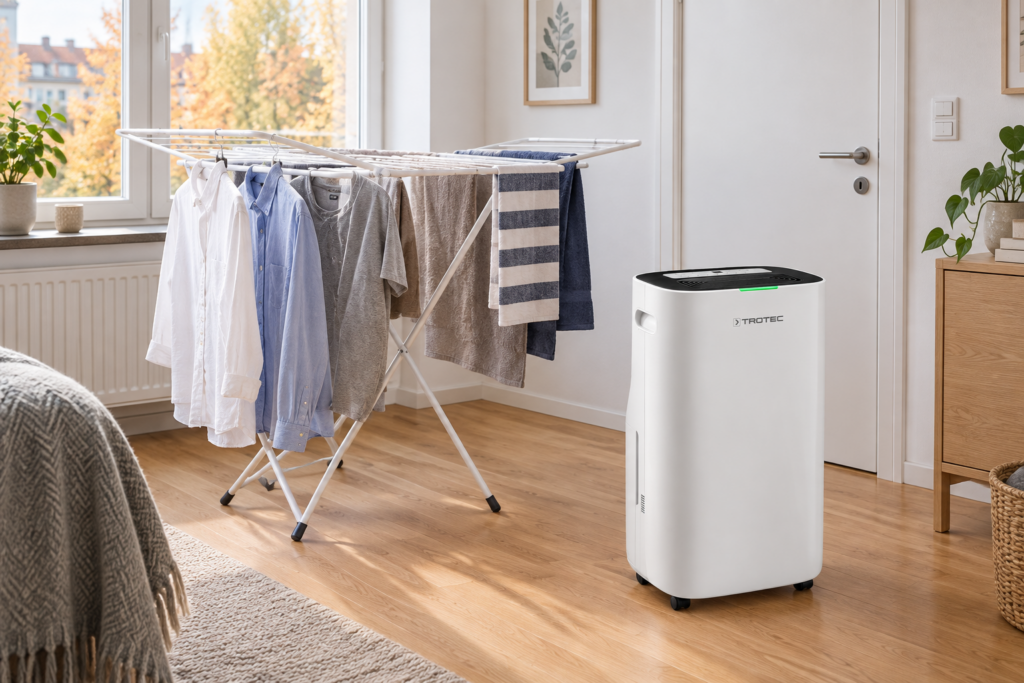
- Run a dehumidifier in laundry mode, aiming to keep room relative humidity below 60%.
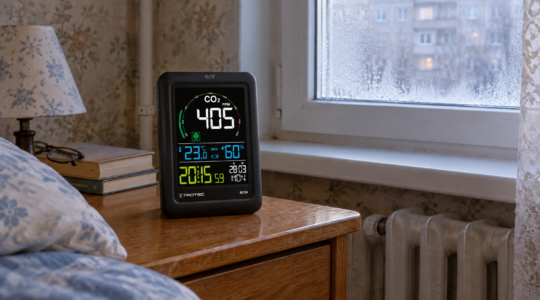
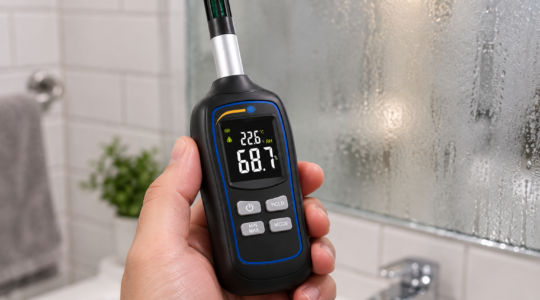
- Track moisture levels with a hygrometer to confirm your routine is actually keeping humidity in check.
How Much Moisture a Single Load of Laundry Releases Indoors
Researchers at the Glasgow School of Art tracked 100 households to measure how much moisture evaporates into the home from indoor drying. Their findings were striking: an average load releases roughly 2 liters of water, which can account for up to a third of all airborne moisture in poorly ventilated homes. For heavier loads weighing closer to 5 kg dry, that figure climbed to around 2.5 liters.
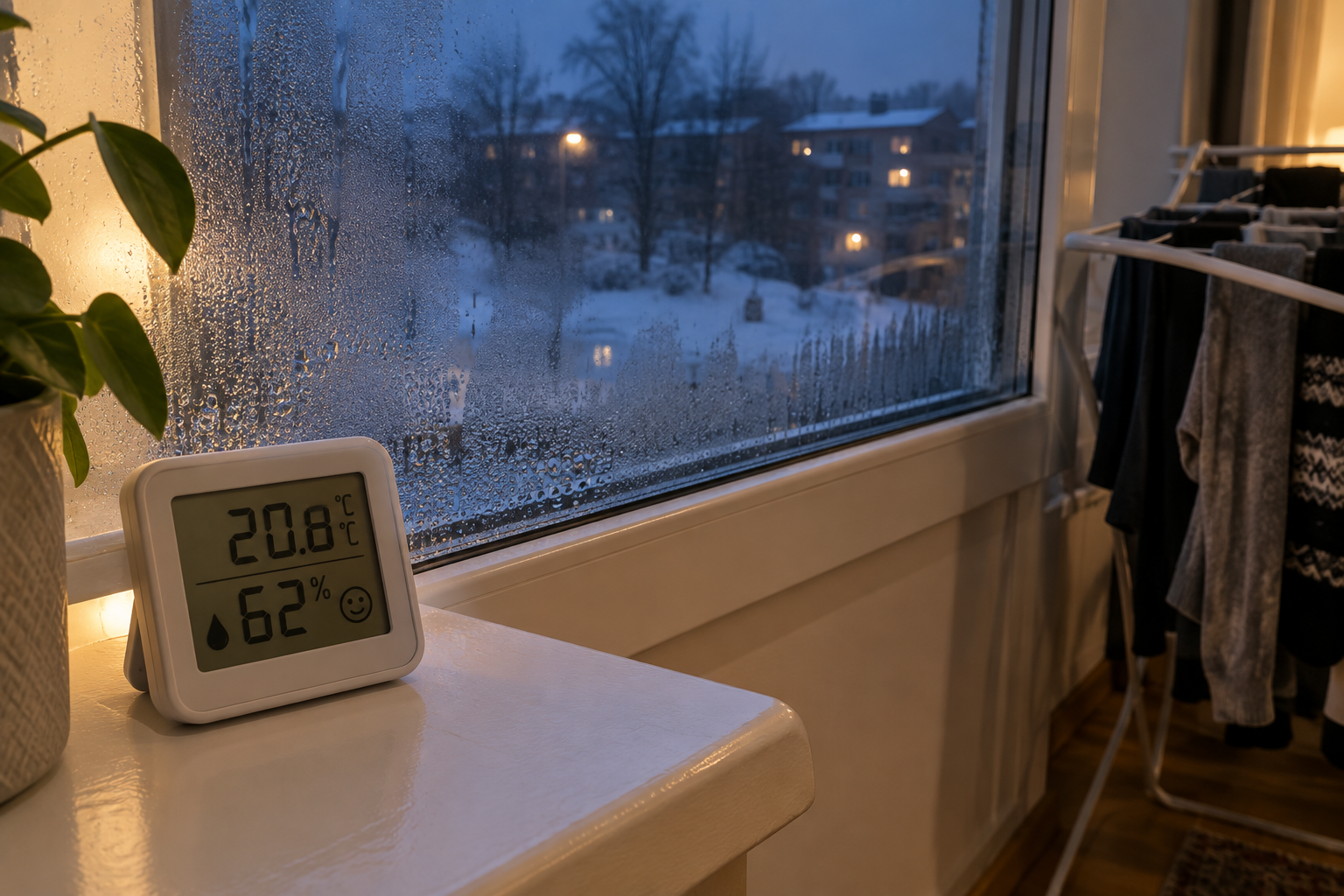
In Estonia, the Health Board recommends keeping indoor relative humidity between 35% and 60% at temperatures of 20–22 °C. During winter, however, that 60% ceiling is far too high. Even when ambient room humidity reads a seemingly comfortable 50%, the localized microclimate beside a cold window reveal or poorly insulated corner can easily hit 100%. That is precisely where condensation pools—and mold can take hold at localized surface humidity levels as low as 70–80%.
This makes indoor drying especially problematic throughout the colder months. Frigid outdoor temperatures discourage people from opening windows, window panes stay cold, and washing two to three loads a week pumps 4 to 6 liters of trapped moisture into the home with no clear exit route.
Start in the Washing Machine: Maximize the Spin Cycle
The less water trapped in the fabric when the cycle finishes, the less vapor evaporates into your living space. Your washing machine’s spin speed makes a substantial difference. According to data from Bosch, cotton fabrics spun at 1,000 RPM retain roughly 62% residual moisture relative to their dry weight. Ramping the spin cycle up to 1,400 RPM drops that residual moisture to around 48%.
Here is how that translates for a standard 4 kg load of dry cotton laundry:
| Spin Speed | Residual Moisture | Retained Water |
|---|---|---|
| 1,000 RPM | ~62% | ~2.5 L |
| 1,200 RPM | ~53% | ~2.1 L |
| 1,400 RPM | ~48% | ~1.9 L |
Opting for a faster spin cycle extracts more than half a liter of extra water right in the drum—water that would otherwise evaporate straight into your living room or hallway. Always check care tags first, however: delicate fabrics like silk, wool, and fine synthetics should be spun at lower speeds to prevent stretching or creasing.
Choose the Right Room and Position Your Drying Rack
The best spot for your clothes horse is a compact room you can completely close off—a bathroom, utility room, spare bedroom, or walk-in storage area. Keeping the door shut contains the moisture in a single zone where an extractor fan or dehumidifier can tackle it efficiently. Leaving doors open simply allows warm, damp air to drift into bedrooms and living spaces, condensing against the coldest exterior surfaces.
Bedrooms are the worst place to dry laundry. Sleeping occupants already exhale substantial amounts of water vapor throughout the night, usually with windows shut and ventilation minimal.
When setting up your drying rack, maximize natural airflow around every garment:
- Leave a few centimeters of space between hanging items.
- Place heavier pieces, like bath towels and denim, along the outer rails where airflow is best.
- Turn thicker items inside out halfway through the drying process.
- Keep the rack away from cold external walls and windows.
Drying wet laundry directly on radiators might seem fast, but it causes more harm than good. Wet garments act as an insulating blanket over the radiator, restricting heat distribution and driving up heating bills. Simultaneously, moisture flashes off the fabric right beneath cold window glass, creating ideal conditions for condensation and mold. Official UK guidance on damp and condensation specifically advises against draping wet clothes over radiators, recommending a standalone clothes airer in a shut-off, cooler room instead.
Drying Laundry with a Dehumidifier: How It Works
A compressor dehumidifier draws humid ambient air across a chilled evaporator coil, causing moisture to condense and drip into an internal collection tank. It then reheats the air slightly before blowing it back out into the room. Because warm, dry air acts like a sponge, moisture evaporates off wet clothes much faster—mimicking the effect of hanging washing outdoors on a breezy afternoon.
Independent testing by British consumer group Which? revealed that running a dehumidifier cuts indoor drying times roughly in half compared to relying on an unassisted clothes airer.
How to Set Up the Unit
- Close all windows and interior doors in the room. An open window pulls in cool outdoor moisture, forcing the unit to run non-stop without making meaningful progress.
- Set the dehumidifier near your drying rack, aiming the dry air outlet directly toward the hanging laundry.
- Select laundry mode. If your model doesn’t have a dedicated laundry preset, set it to continuous mode at maximum fan speed.
- If your unit lets you dial in a target humidity level, Trotec user guides recommend 46% relative humidity for cupboard-dry clothes, 58% for iron-damp garments, and 65% for a quick initial dry.
Once your clothes are dry, switch the unit back to its automatic setting or turn it off. Otherwise, it will continue extracting moisture from the ambient air unnecessarily, adding to your electricity bill.
Choosing the Right Capacity
Dehumidifier capacity is rated in liters per 24 hours. Keep in mind that manufacturers measure this under standard test conditions of 30 °C and 80% relative humidity. In a typical home sitting at 20 °C, actual daily extraction rates will naturally be lower.
- Up to 30 m² and 1–2 loads per week: A 12–16 L/day unit will easily handle the job. The Trotec TTK 53 E extracts up to 16 L per day, covers rooms up to 31 m², and draws 240 W.
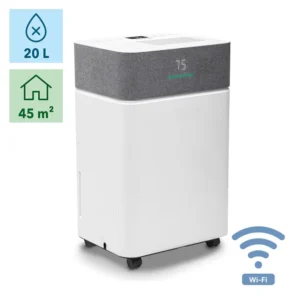
- 40–50 m² and 2–3 loads per week (or busy households with young children): Step up to a 20–24 L/day model. The Trotec TTK 63 E WiFi removes up to 24 L per day, handles spaces up to 45 m², and features convenient app control.
- Homes with allergy sufferers: The Trotec TTK 70 HEPA pairs robust moisture extraction with genuine HEPA filtration for rooms up to 50 m², with a maximum power draw of 420 W.
All three models include a dedicated laundry drying setting. You can explore the full range in our dehumidifiers category.


Cost Breakdown: What Does It Cost to Dry One Load?
Let’s look at the running costs for a typical 4 kg cotton load spun at 1,400 RPM, holding roughly 1.9 liters of residual moisture. Based on an electricity rate of €0.20 per kWh:
Running a powerful model like the TTK 70 HEPA flat-out for five hours consumes roughly 2.1 kWh, which works out to about €0.42. That figure represents the upper limit; once the room hits its target humidity, a humidistat-equipped unit automatically powers down the compressor. In real-world tests conducted by Good Housekeeping, a 20-liter dehumidifier dried an entire wash load in 4.5 hours, using just 1.17 kWh—costing around €0.23 at the same electricity price.
| Drying Method | Energy per Load | Cost (€0.20/kWh) | Where the Moisture Goes |
|---|---|---|---|
| Dehumidifier (20 L class) | ~1.2–2.1 kWh | ~€0.23–0.42 | Collected inside the water tank |
| Heat pump tumble dryer | ~1.0 kWh | ~€0.20 | Collected inside the water tank |
| Vented or condenser dryer | ~2.7 kWh | ~€0.54 | Collected in tank or vented outside |
| Clothes rack (no appliances) | 0 kWh direct | Higher heating & airing costs | Evaporates into indoor living areas |
Tumble dryer consumption numbers reflect European Commission market data: in 2020, heat pump tumble dryers averaged 1.0 kWh per cycle, compared to 2.7 kWh for traditional condenser models using heating elements. From July 1, 2025, only energy-efficient heat pump dryers may be placed on the European Union market.
Purely on electricity per cycle, a dehumidifier won’t necessarily beat a modern heat pump tumble dryer. Its real strengths lie elsewhere: it simultaneously regulates humidity across the entire room, prevents window condensation, stops mold in its tracks, treats fragile fabrics with gentle air drying, and doesn’t require floor space for a bulky, permanent appliance. If you already own a heat pump tumble dryer, use it for standard drying and keep a dehumidifier on hand to stabilize ambient humidity.
Common Mistakes to Avoid
Drying clothes in the living room with open doors. Moisture spreads unhindered throughout the home, settling on cold bedroom window frames or behind large wardrobes positioned against exterior walls. Always isolate laundry in a single room with the door firmly closed.
Leaving windows cracked open all day. During winter, leaving a window slightly tilted merely chills the surrounding masonry and window reveals without exchanging enough air to clear the dampness. Short, vigorous shock-ventilation several times a day is far more effective.
Overcrowding garments on the drying rack. Tightly packed clothes dry slowly and unevenly. If wet laundry remains damp for more than 24 hours, bacteria take over, leaving behind a stale, musty smell that forces you to rewash the entire load.
Guessing room humidity instead of measuring it. Without data, there is no way to know whether your ventilation or dehumidifier is keeping pace. A budget-friendly digital hygrometer gives you real-time visibility; browse our temperature and humidity meters selection. If relative humidity stays north of 60% while washing is on the rack, you have excess moisture to clear.
When This Setup Isn’t the Right Choice
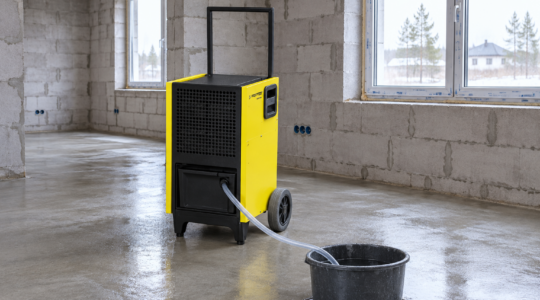
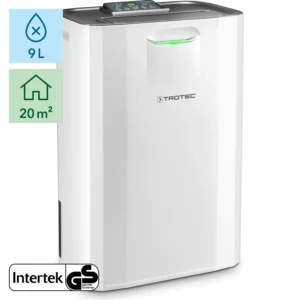
Unheated basements, detached garages, or outbuildings. Standard compressor dehumidifiers lose efficiency rapidly as ambient temperatures plunge. In cold, unheated spaces below 15 °C, a desiccant dehumidifier is a far superior choice. The Trotec TTR 57 E, for example, operates down to 1 °C, removes up to 9 L per day, and features a specialized laundry drying mode. Keep in mind that with a 730 W rating, desiccant models consume more power than residential compressor units.
Active mold growth on interior walls. While a dehumidifier removes the moisture mold needs to thrive, it cannot kill established colonies or repair cold bridges in your building envelope. In multi-unit buildings, the Health Board advises consulting an indoor mycologist or building surveyor. If you discover mold spreading beyond a tiny, isolated spot on a window frame, bring in a professional before attempting remediation.
Your indoor air is already bone-dry. During the coldest stretches of winter, intense central heating can drag indoor relative humidity down to an uncomfortable 20–25%. In those conditions, drying an occasional load of laundry poses zero mold risk and serves as a welcome, natural humidifier. Check your hygrometer: if baseline humidity is comfortably below 50%, you can let your clothes dry naturally without turning on the dehumidifier. For deeper insights, consult our complete guide on ideal indoor humidity levels throughout the year.
At the end of the day, indoor laundry drying is completely manageable—as long as the two liters of water trapped in every load ends up in a drain or collection tank rather than condensing onto your walls and windows. Combine a high-speed spin cycle with a shut-off room and a dehumidifier in laundry mode, and your home will stay warm, dry, and mold-free all winter long.
Frequently Asked Questions
In testing by Good Housekeeping, a 20-liter dehumidifier dried a full load in roughly 4.5 hours. Exact drying times vary based on fabric weight, spin speed, and room dimensions. Tests by Which? showed that a dehumidifier typically cuts air-drying times in half compared to using a drying rack alone.
Yes, provided your bathroom has an active mechanical exhaust fan and you keep the door shut. If ventilation is sluggish, place a dehumidifier in the bathroom or hang clothes when the room isn’t humid from recent showers.
Absolutely. If your dehumidifier allows you to set a custom target humidity, set it to roughly 58%. This leaves just enough residual moisture in the weave to make pressing wrinkles fast and effortless.