As summer heatwaves become more frequent and intense, homeowners and businesses alike are turning to dedicated cooling solutions. Yet, investing in air conditioning often brings up valid concerns about running costs: will keeping your space cool cause your electricity bills to spike, or are modern units efficient enough to run affordably?
An air conditioner’s actual power draw depends on its cooling capacity, underlying technology, the heat load of the building, and how you use it day to day. This guide breaks down how to calculate power consumption, explains essential energy efficiency metrics, and shares practical tips for keeping your indoor climate comfortable while keeping power bills to a minimum.
Cooling Capacity vs. Power Consumption: What Is the Difference?
A common point of confusion when comparing air conditioners is mistaking cooling capacity for electrical power consumption. When a specification sheet lists a cooling capacity of 3.5 kW (roughly 12,000 BTU/h), that does not mean the system draws 3.5 kilowatt-hours of electricity from the grid every hour.
Air conditioners do not produce cold air by directly “burning” electricity. Instead, they operate on a heat pump cycle, using refrigerant to absorb thermal energy from inside the room and transfer it outdoors.
- Cooling capacity (kW or BTU/h): The rate at which the unit removes heat energy from a room over a given period.
- Power consumption / Input power (kW or W): The actual electrical power the compressor, fans, and internal electronics draw from the mains.
A modern air conditioner rated at 3.5 kW of cooling capacity typically consumes only 0.8 to 1.2 kW of electrical power. In other words, for every kilowatt-hour of electricity consumed, the system generates 3 to 4 times that amount in cooling output.
How to Calculate Air Conditioner Power Consumption and Electricity Costs
Estimating the day-to-day running cost of an air conditioner takes just a few straightforward calculations.
Converting Input Power to Kilowatts (kW)
Check the rating plate on the unit for its nominal input power in watts (W), then divide that number by 1,000 to convert it into kilowatts (kW). For instance, an input rating of 1,100 W is 1.1 kW.
Calculating Electricity Consumption (kWh)
Multiply the input power by the number of operating hours to determine total electricity use. If a 1.1 kW unit runs at full capacity for 5 hours, the calculation is:
1.1 kW × 5 h = 5.5 kWh
Calculating Financial Cost (€)
Multiply total kilowatt-hours consumed by your all-inclusive electricity tariff—incorporating the wholesale electricity price, network transmission fees, renewable energy levies, and VAT. At an average rate of €0.18/kWh, running the unit for 5 hours costs:
5.5 kWh × €0.18/kWh = €0.99
To project monthly running costs, simply multiply this daily expense by your expected number of cooling days. If you are on an hourly dynamic or spot-price tariff, electricity rates vary throughout the day; scheduling your cooling cycles during cheaper, off-peak hours will bring costs down even further.
Energy Efficiency Ratings: EER, SEER, and Energy Labels
Standardized ratings make it easy to evaluate and compare the energy efficiency of different air conditioning systems:
- EER (Energy Efficiency Ratio): Measures instantaneous efficiency by comparing cooling output to power input under fixed laboratory conditions (typically at an outdoor temperature of +35 °C). A higher EER means the unit delivers more cooling per watt of electricity.
- SEER (Seasonal Energy Efficiency Ratio): Measures real-world efficiency across an entire cooling season, factoring in part-load performance and fluctuating outdoor temperatures. SEER provides a much more accurate forecast of annual energy consumption.
Under the European Union energy labeling scheme, residential air conditioners are classified by SEER into standard efficiency tiers:
- A+++: SEER 8.50 or higher
- A++: SEER 6.10 to 8.49
- A+: SEER 5.60 to 6.09
- A: SEER 5.10 to 5.59
- B: SEER 4.60 to 5.09
- C: SEER 4.10 to 4.59
Top-tier units use variable-speed inverter compressors that modulate output smoothly to match the room’s real-time cooling demand. This avoids the energy spikes and unnecessary wear associated with traditional fixed-speed on/off cycling.
Factors That Affect Real-World Energy Consumption
While energy labels provide a standardized baseline, real-world electricity usage varies according to several key factors:
- Building heat load and thermal insulation: Large south-facing windows, unshaded glazing, thin exterior walls, and poor roof insulation allow heat to build up rapidly. Internal heat sources—such as occupants, appliances, computers, and lighting—also add to the cooling load.
- Outdoor temperature and cooling demand: The wider the temperature difference between inside and outside, the harder the compressor must work. Sustained heatwaves naturally increase runtime and power draw.
- Thermostat settings: Lowering your target temperature by just a single degree noticeably increases electricity consumption. Setting your thermostat to 27 °C rather than 22 °C can reduce energy use by up to 50%. A balanced, healthy target for indoor summer comfort is typically 23–25 °C.
- Airflow and maintenance: Dust-laden filters and fouled heat exchangers restrict airflow and reduce heat transfer efficiency, forcing the unit to run longer and consume more power.
Types of Air Conditioners and Their Energy Consumption
Cooling systems vary widely in configuration, installation requirements, and overall efficiency.
Portable Air Conditioners for Home and Office
Portable units are a versatile option for rented properties or rooms where structural modifications are not feasible. They exhaust heat outside via a flexible hose. Most modern units draw between 0.8 and 1.4 kWh per hour and include built-in dehumidification and fan modes. Explore available models in the portable air conditioners for home and office section.
-
-13%
 Available
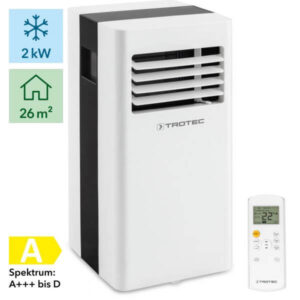
PAC 2100X Portable Air Conditioner
Original price was: 399 €.349 €Current price is: 349 €.
-
-8%
 Available
Powerful PAC 3910 X WiFi Portable Air Conditioner (4.1 kW, 14,000 Btu) for up to 52 m²
Original price was: 649 €.594 €Current price is: 594 €.
-
 Available
Remko RKL 355 ECO Portable Air Conditioner
744 €
-
-32%
 Available
Trotec PAC 2020 E WiFi Portable Air Conditioner – 2.0 kW
Original price was: 399 €.270 €Current price is: 270 €.
Sealing the window opening around the exhaust hose is essential to prevent warm air from infiltrating the room; read our detailed guide on choosing a portable air conditioner for an apartment.
Monoblock Air Conditioners Without an Outdoor Unit
When local building regulations, heritage protections, or aesthetic preferences rule out mounting a condenser on the exterior facade, monoblock air conditioners offer a practical alternative. All cooling components are contained within a single indoor unit that connects to the outside through two discrete wall vents. Browse our range of outdoor-unit-free monoblock air conditioners.

Split System Air Conditioners
Split system air conditioners deliver the highest seasonal efficiency and whisper-quiet operation by separating the outdoor condenser from the indoor evaporator unit. Portable split models are also available, combining mobile flexibility with the superior efficiency of split technology.
-
-14%
 Available
PAC 4600 Split Mobile Air Conditioner
Original price was: 2 099 €.1 799 €Current price is: 1 799 €.
-
 Available
Quiet PureAirPro DuoClima 35 Portable Split Air Conditioner/Heat Pump
1 098 €
-
 Available
REMKO ML 265/355/525/685 DC Air Conditioner for Rooms Up to 230 m³
Price range: 1 835 € through 3 338 €
High-Performance Commercial Portable Units
Demanding commercial environments—such as production halls, server rooms, workshops, and temporary event venues—require heavy-duty portable systems capable of handling high thermal loads. Discover heavy-duty options in the commercial portable air conditioners catalog.

Practical Tips to Reduce Air Conditioning Electricity Costs
Keep your running costs down with these simple operational adjustments:
- Block direct solar gain: Close blinds, curtains, or external shutters on sun-exposed windows during peak daylight hours. Light-colored window coverings reflect radiant heat, lowering the cooling demand on your system.
- Ventilate strategically: Open windows during cool early mornings and late evenings to flush the space with fresh air. Keep doors and windows firmly shut during the heat of the day.
- Choose realistic target temperatures: Avoid overcooling by setting excessively low temperatures (such as 18 °C). Maintaining a steady 23–25 °C keeps the space comfortable without forcing the compressor to run continuously at maximum output.
- Use smart controls and timers: Set up automated schedules or use Wi-Fi controls to pre-cool your space ahead of time, taking advantage of cheaper off-peak electricity windows.
- Seal exhaust pathways: If you use a portable air conditioner, fit a tailored window seal kit to stop hot exhaust air from circulating back indoors.
- Keep filters clean: Inspect and rinse indoor air filters every couple of weeks to ensure unrestricted airflow and maintain peak heat-exchange performance.
Efficient Indoor Climate Solutions from Pro Air
Optimizing your cooling costs begins with correctly sizing equipment for your specific space. An undersized unit will run non-stop at maximum load, wasting energy, while an oversized unit leads to unnecessary upfront capital expenses and uneven cooling.
Since 2017, Pro Air OÜ has provided tailored indoor climate solutions for residential, commercial, and industrial properties. Our lineup features high-quality equipment from leading European manufacturers—including Trotec, REMKO, and Innova—available for both purchase and hire. We handle the entire project lifecycle, from heat-load assessments and equipment sizing to installation and long-term maintenance. Contact our team at info@proair.ee or call +372 5332 2258 / +372 5670 4022 to find the right energy-efficient cooling system for your space.
Frequently Asked Questions
A typical residential system (drawing roughly 0.8–1.2 kW of electrical power) running for six hours consumes between 3 and 6 kWh of electricity. Based on an all-inclusive electricity rate of €0.18/kWh, the estimated daily operating cost is around €0.55 to €1.10.
For modern inverter units, maintaining a consistent temperature is generally more economical. Allowing walls, floors, and furniture to absorb heat during the day forces the unit to work at full capacity for hours to cool the room back down, drawing far more total energy than running continuously at a steady, low-load state.
A clogged filter restricts airflow across the evaporator coil, severely limiting heat transfer. To compensate, the compressor must run longer and under higher pressure, increasing overall electricity consumption by 10% to 25%.