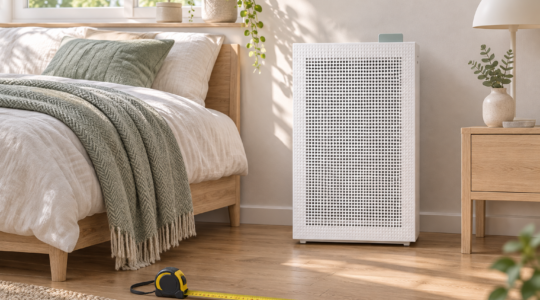
A dehumidifier can only remove moisture from the air that actually passes through it. For that reason, strategic placement matters just as much as extraction capacity: a unit shoved into a cramped corner or tucked behind laundry will run non-stop while pulling surprisingly little water from the room.
To get the most out of your dehumidifier, keep these core principles in mind:
- Set up the unit in an open area, well away from corners and bulky furniture. Keep both the intake and outlet grilles entirely unobstructed.
- Follow the minimum clearance guidelines outlined in your model’s user manual. Required clearances typically range from 10 cm to 50 cm depending on the machine.
- Position the unit on a flat, level floor, and make sure condensate drains smoothly—either via a properly sloped hose or into an onboard tank that is emptied regularly.
- Keep exterior doors and windows closed whenever the machine is running.
- Never install a standard dehumidifier inside a bathroom; instead, position it just outside the doorway in the hall.
Here is a closer look at clearance requirements, optimal room layouts, and proper drainage setups.
Clearances: Air Must Circulate Freely Through the Unit
Dehumidifiers work by drawing in humid ambient air, extracting the moisture, and discharging warm, dry air back into the living space. When the intake or exhaust is blocked, the appliance ends up cycling the same pocket of air over and over. This localized recirculation drives up energy consumption and leaves the rest of the room damp.
Clearance specifications vary widely across brands and capacities. For example, the manual for the Trotec TTK 70 S requires at least 30 cm of overhead clearance, 20 cm at the back and sides, and 10 cm in front. By comparison, larger commercial-grade units like the Trotec TTK 165 ECO demand at least 50 cm of clearance on every side.
Example: The TTK 70 S has a physical footprint of 185 mm wide by 378 mm deep. Once you factor in mandatory operating clearances, it actually requires an unobstructed floor area of roughly 59 × 68 cm (18.5 + 20 + 20 cm in width, and 37.8 + 20 + 10 cm in depth), as well as open space above the exhaust. Measure your intended floor space before buying, not after.
A few practical installation rules:
- Keep curtains, hanging laundry, and upholstery well clear of all air grilles.
- Always stand the unit upright on a solid, level surface. Remember that a full water tank adds noticeable weight: the TTK 70 S weighs 12.4 kg empty, and a full 4-liter tank adds another 4 kg.
- Back-to-wall placement is only acceptable if the manufacturer’s documentation explicitly permits it.
Room Placement: Center of the Room or Near the Moisture Source?
As a general rule, position the unit centrally or place it in an open corridor between the moisture source and the rest of the space. Tucking the appliance into a distant corner—even if that corner shows signs of dampness—rarely works. The dehumidifier will simply pull from the stagnant air immediately surrounding it, leaving the opposite side of the room untouched.
Use this approach to determine the best spot:
- Localized moisture (such as outside a steamy bathroom or beside a clothes airer): Position the unit near the damp zone, aiming the exhaust airflow out toward the wider room.
- Widespread humidity (visible window condensation or a lingering musty smell throughout): Place the unit in the middle of the room for balanced circulation.
- Multiple rooms: A single residential unit cannot effectively dry adjacent rooms if the doors between them stay shut. Tackle the dampest room first, track relative humidity with a hygrometer, and consider adding a second unit if needed.
If you are unsure which capacity matches your square footage, explore our dehumidifier buying guide.
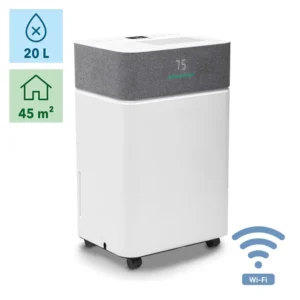
For medium-to-large bedrooms and living areas, popular options include the Trotec TTK 63 E WiFi (suitable for spaces up to 45 m²) and the TTK 70 HEPA (up to 50 m²).

Doors and Windows: Smaller Spaces Dry Faster
A dehumidifier conditions the total volume of air inside an enclosed zone. The greater the air volume, the longer the process takes. Leaving interior doors open forces the appliance to pull moisture from adjoining areas, while an open window constantly draws in fresh outdoor moisture that may be more humid than the air indoors.
To maximize efficiency:
- Shut all exterior windows and doors while dehumidifying. The Trotec TTK 75 E manual explicitly states that open doors and windows must be avoided—a rule that applies equally when drying wet laundry indoors.
- Air out the room briefly beforehand if needed, then shut the windows tight before turning the machine on. Never run a unit beside a cracked window.
- If you must keep a door ajar to route a drainage line, open it only as wide as necessary and ensure the door does not pinch or kink the hose.
Drainage: Hoses, Slopes, and Condensate Pumps
Internal water tanks fill rapidly under humid conditions. Operating at peak extraction (up to 24 liters per day), the TTK 70 S will fill its 4-liter reservoir in roughly four hours. For unattended operation, overnight use, or damp basements, setting up a continuous drain hose is the most reliable approach.

Best practices for gravity drainage hoses (based on Trotec manufacturer guidelines):
- The hose must slope downward continuously along its entire run. The discharge outlet must sit lower than the connection port on the machine; any dip, loop, or upward incline creates an airlock that forces condensate to back up.
- Keep the line free of kinks, sharp bends, and pinches.
- Match the internal diameter specified by your manufacturer. For instance, Trotec manuals call for a 10 mm inner diameter on models like the TTK 27 HEPA and TTK 64 HEPA, 12 mm for the TTK 165 ECO and TTK 170 ECO, and 16 mm for the commercial TTK 570 ECO. Always verify the required hose size before installation.
- Terminate the hose into a floor drain, utility sink, dedicated waste pipe, or an appropriately sized collection vessel.
When the nearest drain or sink sits higher than the dehumidifier’s outlet port, gravity drainage is not an option. You will need an external condensate pump instead. For example, Trotec offers an optional pump kit for its TTK 140 S through TTK 650 S range with a lift height of up to 4 meters. Verify compatibility with your specific model before purchasing.
Finally, never run an unheated drain line outdoors in sub-zero weather: standing water in the hose will freeze, blocking the line and causing the unit to overflow.
Special Locations: Basements, Laundry, and Bathrooms
Basements and Unheated Spaces
In unheated basements, ambient temperature is just as important as clearances. Standard compressor (refrigerant) dehumidifiers operate within a specific temperature window; for the TTK 70 S, that range is 5–35 °C. Below roughly 10 °C, the evaporator coils rapidly frost over, forcing the machine into repeated defrost cycles that sharply reduce daily water extraction. For chilly basements, detached garages, or winter cabins, a desiccant (adsorption) dehumidifier is significantly more effective because it extracts moisture without relying on cold condensing coils.
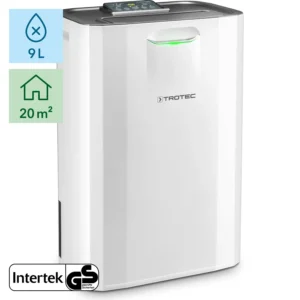
The Trotec TTR 57 E, for example, is a desiccant model built for reliable continuous drying in unheated areas up to 20 m². Give it plenty of breathing room, and avoid placing it behind tall metal shelving or storage racks.
Explore more low-temperature options in our desiccant dehumidifiers category. Keep in mind that enclosed storage areas, wardrobes, and dark corners dry very slowly without airflow: prop cupboard doors open and pull boxes away from cold perimeter walls to promote air movement.
Drying Laundry
When using a dehumidifier to dry clothes, choose a compact, enclosed room. Position your drying rack so dry exhaust air blows across the garments rather than against an empty wall. Maintain the clearance distances listed in your manual, and ensure soaking-wet clothes cannot drip water onto the casing or electrical components.
Bathrooms
Electricity and standing water are a hazardous mix: VDE safety standards recommend keeping electrical appliances away from showers and bathtubs. Most residential dehumidifiers lack the IP moisture-ingress rating required for wet zones. The safest and most practical approach is to set the dehumidifier in the adjoining hallway, pointing into the bathroom with the door propped open after bathing.
What to Do When Space Is Limited
In compact flats or studio layouts, dedicating the middle of the room to an appliance is not always realistic. If space is at a premium, use this three-step strategy:
- Compare clearance specs before choosing a model. Some compact units need only 10 to 20 cm of perimeter clearance, whereas larger units need 50 cm. That difference alone can dictate whether a unit will work in your floor plan.
- Use a hallway as a central hub. Placing the dehumidifier in a central corridor with adjacent bedroom doors open allows air to circulate between rooms without cluttering your main living areas.
- Verify airflow with a hygrometer. Set up a standalone humidity meter at the opposite end of the room. If relative humidity drops consistently throughout the entire space, your placement is effective. If only the area right next to the dehumidifier dries out, move the machine to a more open location.
The target is simple: the US EPA recommends maintaining relative humidity below 60%, ideally between 30% and 50%. Watch for condensation along window panes or chilled perimeter walls as an early warning sign of elevated moisture.
Controlling indoor humidity comes down to a few sound habits: give your dehumidifier adequate clearance, keep doors and windows shut during operation, and set up a sloped drain line for uninterrupted performance. Explore our complete selection of residential and commercial models in the dehumidifiers category, or contact the team at Pro Air for personalized advice on your layout.
Frequently Asked Questions
Only if your model’s user manual explicitly permits it. Most portable dehumidifiers require between 10 cm and 50 cm of clearance around all sides to ensure adequate airflow. For example, the Trotec TTK 70 S requires at least 20 cm at the back and sides, 30 cm above, and 10 cm in front.
Generally not if the doors between those rooms are closed. Dehumidifiers perform best in a single enclosed space. To treat adjacent rooms, set the unit in the damper area first with the doors open, and monitor humidity levels in the adjoining room with a separate hygrometer.
Use a continuous drain hose for overnight drying, damp basements, or extended unattended use. At peak extraction, a 4-liter tank can fill in around four hours. If your drain outlet or sink is higher than the unit’s discharge port, you will need to add an external condensate pump.