If your dehumidifier is running but the water tank remains completely dry, the unit isn’t necessarily broken. In most cases, the room has simply reached your target humidity, the ambient air is too cold for a compressor model to work efficiently, or the reservoir, float switch, or drain hose is misaligned. Before assuming the worst, it pays to rule out these everyday culprits.
Before calling a repair technician, run through this quick three-step checklist (it takes less than ten minutes):
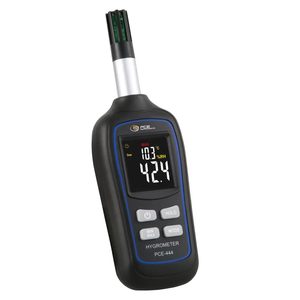
- Place an independent hygrometer in the room and compare its reading to the dehumidifier’s target humidity setting.
- Check the room temperature near the unit. If it drops below 15 °C (59 °F), a standard compressor dehumidifier will lose efficiency rapidly.
- Pull out the water tank, verify that the float switch moves freely, and slide the tank firmly back into place. Ensure a continuous drain hose hasn’t been left connected by mistake.
Below, you will find the most common causes, their telltale symptoms, practical fixes, and guidance on when to seek professional repairs.
Quick Reference: Symptoms, Causes, and Solutions
| What You See | Likely Cause | What to Do |
|---|---|---|
| Fan runs, compressor stays silent, room humidity is below the setpoint | Target humidity reached | Lower the humidity setpoint or switch to continuous mode |
| Evaporator coils are frosted over; room temperature is below 15–18 °C | Ambient air is too cold; defrost cycle is active | Heat the room or switch to a desiccant dehumidifier |
| Unit won’t turn on; “tank full” indicator is illuminated | Tank is full, unseated, or float is stuck | Empty the reservoir, reseat it squarely, and free the float switch |
| Unit runs and the tank is dry, but water is puddling or draining away | Drain hose is connected, blocked, or leaking | Check hose setup; decide between the tank or continuous drainage |
| Airflow feels weak; unit runs hot | Clogged air filter or blocked intake/exhaust grilles | Clean or replace the filter; clear space around the unit |
| Water collects in the tank, but room humidity refuses to budge | Unit is undersized or moisture is continuously entering the space | Close windows/doors, fix leaks, or upgrade to a larger unit |
1. The Room Has Already Reached Your Target Humidity
This is the most common false alarm. Units fitted with an internal humidistat automatically cut power to the compressor once the room’s relative humidity (RH) drops to your chosen threshold. The fan may continue running for a few minutes to keep air circulating and sample ambient conditions. Many humidistats operate with a built-in hysteresis buffer of roughly ±3%, which prevents the unit from cycling on and off excessively.
Because the onboard sensor sits inside the chassis and reads air entering the intake, its reading can differ slightly from an external room hygrometer. A discrepancy of 5–8% between devices is entirely normal. For an accurate comparison, place your standalone hygrometer in the center of the room rather than right beside the dehumidifier’s exhaust.
What should your target humidity be? The ASHRAE Handbook recommends an indoor range of 40–60% RH for optimal comfort and respiratory health. A WHO review on indoor dampness notes that keeping relative humidity below 75–80% prevents mold from taking hold on vulnerable building materials. For most living spaces, a setting of 50–55% strikes the right balance. To verify that your compressor still works, simply drop the setpoint to its lowest value or switch the unit to continuous mode for a couple of hours.
2. The Room Is Too Cold
Compressor dehumidifiers draw ambient air across refrigerated evaporator coils, chilling it below its dew point so moisture condenses and drips into the tank. In a chilly room, however, those coils drop below freezing, causing frost and ice to accumulate on the fins. Most compressor models operate best at temperatures above 15 °C. When ice builds up, an automatic sensor shuts down the compressor while keeping the fan running to melt the frost. During this defrost cycle, the machine cannot extract moisture, even though it sounds like it is running.
Some compressor units handle cold conditions better than others. For instance, the TTK 70 HEPA available from Pro Air is rated for operation down to 5 °C (operating range: 5–32 °C), and the REMKO ETF 360 ECO functions between 6–32 °C. Even so, moisture extraction drops dramatically near the lower end of those ranges.
Consider the drop in performance: according to REMKO ETF 600 ECO technical specifications, the unit extracts 58.6 liters per 24 hours at 30 °C and 80% RH. At 20 °C and 70% RH, that rate falls to 34.3 liters—a decline of nearly 41%, despite still being at room temperature. If you run a compressor dehumidifier in an unheated basement, garage, or cabin, an empty tank is usually a matter of basic physics rather than a broken machine.
A light frost during startup is normal and typically clears within 30–45 minutes. If heavy ice builds up across the coils:
- Turn off the dehumidifier and unplug it.
- Let the ice melt naturally at room temperature. Never chip away at ice with sharp tools or use a heat gun or hairdryer, as this can puncture the delicate aluminum fins or rupture the refrigerant coils.
- Raise the room temperature to at least 18–20 °C, or switch to a system engineered for cold climates.
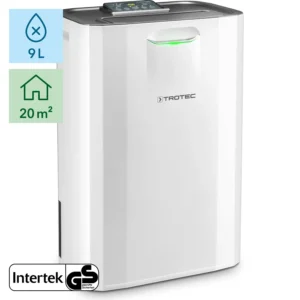
For unheated basements, garages, and winterized vacation homes, a desiccant dehumidifier is usually the superior choice. Desiccant units use an absorbent desiccant rotor instead of a compressor and cold coils, meaning their extraction rate remains stable regardless of how cold the room gets. According to Pro Air, the Trotec TTR 57 E delivers reliable, continuous drying in unheated spaces up to 20 m².
3. The Water Tank Is Full, Misaligned, or the Float Is Stuck
Virtually all modern dehumidifiers include an automatic shut-off mechanism that trips whenever the collection tank is full, removed, or improperly seated. A small buoyant float inside the bucket moves with the water level; when it reaches the top, it trips a microswitch that cuts power to the compressor and fan.
If that float becomes wedged in the “up” position by dirt, scale, or shipping tape—or if the tank isn’t seated completely flush against the chassis—the machine will refuse to run. Naturally, it cannot collect water if the compressor never starts.
To fix this, slide the tank out, empty it, and wash away any biofilm or mineral buildup that might impede the float. Check that the float moves freely on its hinge, then push the bucket firmly into place until you hear it click. Never bypass or tape down the float switch; disabling this safety feature invites overflowing tanks and water damage to your floors.
4. Water Is Draining Through the Hose Instead of the Tank
Most domestic dehumidifiers feature a continuous drainage port where you can attach a hose to bypass the internal collection bucket. When this port is open or a hose is plumbed in, water flows straight out to a drain or external container. The machine may be pulling moisture out of the air at full capacity, but the internal bucket will remain bone dry.
Trace the line to see where the condensate is going:
- Ensure the drain hose slopes steadily downward toward a floor drain, sump pit, or sink. Any kinks, loops, or upward slopes will create airlocks or cause water to back up into the cabinet and spill onto the floor.
- If you intend to use the collection bucket, check that the continuous drain cap or rubber bung is securely closed.
- Certain models, such as the Fral Flipperdry 300 ECO, accommodate permanent drainage setups while also featuring a generous 5.5 kg internal collection tank.
- On units equipped with an internal condensate pump, keep in mind that the pump only cycles on once its small internal reservoir fills up, rather than draining continuously.

5. The Air Filter Is Clogged or Airflow Is Blocked
According to Pro Air maintenance guidelines, a dust-choked air filter chokes off airflow, drives up power consumption, and puts unnecessary strain on the fan motor. Without adequate air passing across the evaporator coils, fewer water molecules condense out of the air, causing extraction rates to plummet.
The same problem occurs if the intake or exhaust grilles are blocked. Never push a dehumidifier flush against a wall, bury it under coats, or tuck it behind heavy drapes or furniture. Give the appliance at least 30–50 cm of clear space on all sides.
Clean or replace the air filter on a regular schedule according to the manufacturer’s instructions. On units with combination HEPA filtration—such as the TTK 70 HEPA—keeping the filter clean is vital for maintaining both particle removal and balanced static pressure. How often you clean or replace the filter depends on household dust and operating hours. Always replace filters with genuine, model-specific parts, and never operate a dehumidifier without a filter in place; airborne dust will settle directly onto wet coils, breeding mildew and causing stubborn clogs.

6. The Dehumidifier Type Doesn’t Match the Environment
Not all dehumidifiers operate on the same principle, and choosing the wrong type for your space will leave you disappointed:
- Refrigerant / Compressor dehumidifiers: The standard choice for domestic spaces. Highly efficient between 15–30 °C, but prone to frost and reduced extraction in cold environments.
- Desiccant (rotor) dehumidifiers: These extract moisture using an absorbent wheel (such as silica gel). They work reliably in low-temperature environments down to near-freezing, though they consume slightly more electricity and release gentle heat back into the room. Keep in mind that some commercial desiccant units vent moisture outside as warm, humid air through flexible ductwork rather than collecting liquid water in a tank.
- Peltier (thermoelectric) dehumidifiers: Ultra-compact, silent devices that use a small solid-state heat sink. They typically extract only 0.5 to 1 liter of water per 24 hours under ideal conditions. They are suited only for small, enclosed spaces like closets, pantries, or gun safes—not entire rooms.
If you are shopping for a new unit, our dehumidifier buying guide breaks down how to match technology and capacity to your square footage.
7. The Unit Is Undersized or Moisture Keeps Entering the Room
What if the bucket fills with water, but the room’s relative humidity never seems to budge? This doesn’t mean your dehumidifier is broken—it usually means the moisture load outpaces the machine’s capacity.
Manufacturer ratings are based on idealized laboratory conditions (typically 30 °C and 80% RH). For example, the TTK 64 HEPA available from Pro Air is rated for 20 liters per 24 hours under those peak conditions. In a normal living room at 20 °C and 60% RH, actual extraction will be substantially lower.
Do the math: a 20-liter-per-day machine averages roughly 0.8 liters per hour at peak load. A 6.5-liter tank (like the one on the TTK 70 HEPA) would take about eight hours to fill under lab conditions, and far longer in everyday domestic use. If your bucket takes days to fill, check your hygrometer to confirm whether the room actually contains enough excess moisture to warrant collection.
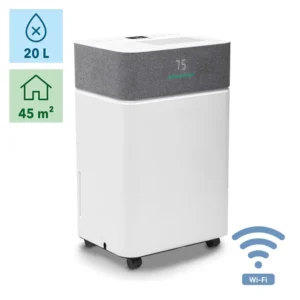
Furthermore, an undersized unit cannot keep up if fresh moisture is continually entering the space. Common culprits include open windows on damp days, unvented tumble dryers, wet laundry hung indoors, wet construction materials (curing screed or plaster), or chronic foundation seepage. Close all exterior windows and doors, isolate laundry drying to a single closed room, and address any active leaks. For larger spaces or persistent dampness, upgrade to a higher-capacity unit from Pro Air’s dehumidifier range. The Trotec TTK 63 E WiFi, for example, extracts up to 24 liters per day and is rated by Pro Air for rooms up to 45 m².
8. When It’s a Genuine Defect and Needs Professional Servicing
If you have worked through all the troubleshooting steps above and the unit still refuses to pull moisture from humid air, an internal component has likely failed. Contact a service technician if you notice any of the following:
- The room is warm (above 18–20 °C), the filter is clean, the tank is seated correctly, ambient RH is well above the setpoint, yet no water collects after 24 hours;
- The fan runs, but the compressor never kicks in, and the exhaust air remains at ambient temperature rather than feeling warm;
- Evaporator coils freeze into a solid block of ice even in a warm room (often a sign of a refrigerant leak or failing expansion valve);
- The control panel displays a persistent error code, or the digital hygrometer reads wildly inaccurate values;
- Water pools directly beneath the chassis rather than draining into the tank or hose;
- The machine emits an acrid burning smell, produces loud metallic grinding noises, or trips the circuit breaker.
What you should never attempt yourself: do not puncture, cut, or dismantle the refrigeration lines, do not attempt DIY refrigerant recharges, and never tamper with the electrical float switches. Under the EU F-Gas Regulation, all installation, maintenance, and recovery work involving fluorinated greenhouse gases must be performed exclusively by certified refrigeration specialists. If you suspect a sealed-system leak or compressor failure, switch the unit off, unplug it, and call in an expert.
For technical support or repair inquiries regarding Pro Air equipment, reach out to info@proair.ee or call +372 5332 2258. Please have your exact model number, current room temperature, ambient humidity, and a brief description of the issue ready when you call.
In the vast majority of cases, a dry dehumidifier tank simply means the room is already dry, the space is too cold, or the water is draining through a hose. Take an objective reading of your room’s temperature and humidity first—the numbers will almost always point you toward the right fix.
Frequently Asked Questions
Yes. Compressor dehumidifiers naturally generate heat as a byproduct of the refrigeration process. As air passes across the warm condenser coils, it picks up heat, warming the exhaust air by a few degrees. This is completely normal and indicates that the compressor is operating properly.
During initial startup in a cool room, clearing frost can take between 30 and 45 minutes. Routine automatic defrost cycles during normal operation typically last anywhere from 5 to 30 minutes, depending on ambient room temperature and moisture levels. Let the cycle run its course; never interrupt it unless directed by your user manual.
Standard domestic compressor dehumidifiers experience a steep drop in efficiency below 15 °C. While versatile models like Pro Air’s TTK 70 HEPA are rated down to 5 °C (range: 5–32 °C), their actual extraction rate is much lower in cold air. If your space consistently stays below 12–15 °C, a desiccant dehumidifier will collect moisture far more reliably.