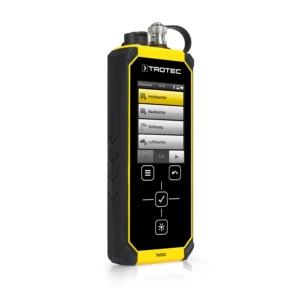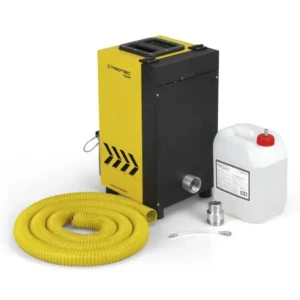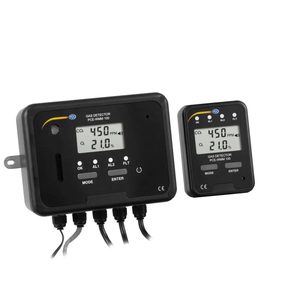


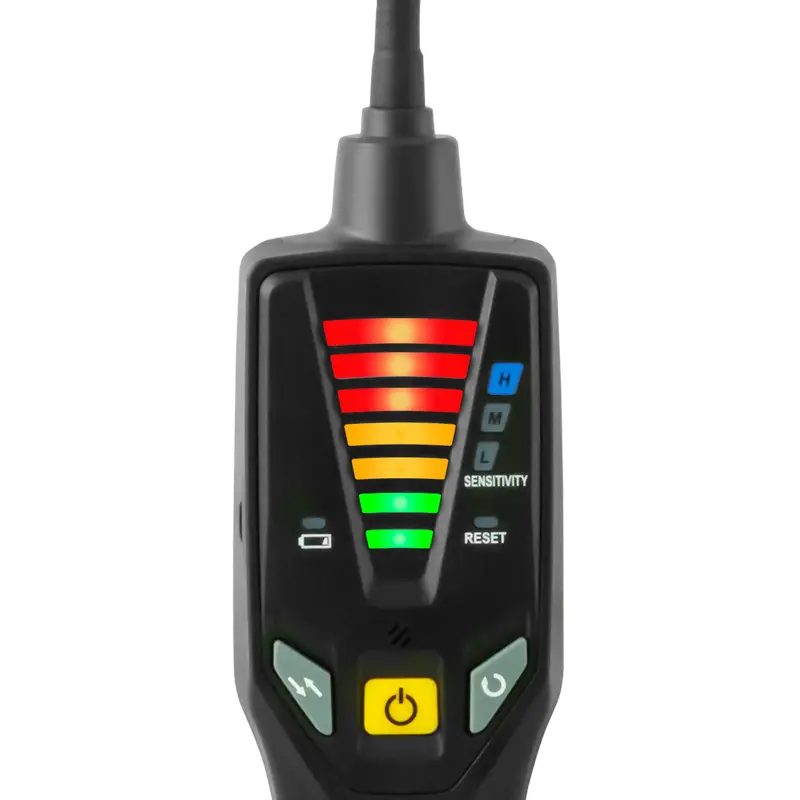



Environmental Meter With acoustic alarm and visual display / Semi-rigid 40 cm (15.7″) long hose / Different sensitivities adjustable / Detection starts at less than 5 ppm
Hydrogen not only offers possibilities as an energy carrier and energy storage that have not been used so far. Due to its physical properties, it is also ideally suited for detecting leaks. With its hydrogen-selective sensor, the Refrigerant Gauges can detect the smallest leaks with a very low leak rate. Containers or lines that do not contain hydrogen can also be checked for leaks with the gas detector if they are filled with test gas containing hydrogen and then checked for leaks. The forming gas with five percent hydrogen and ninety-five percent nitrogen, which is already commercially available for other technical purposes, is well suited for leak tests.
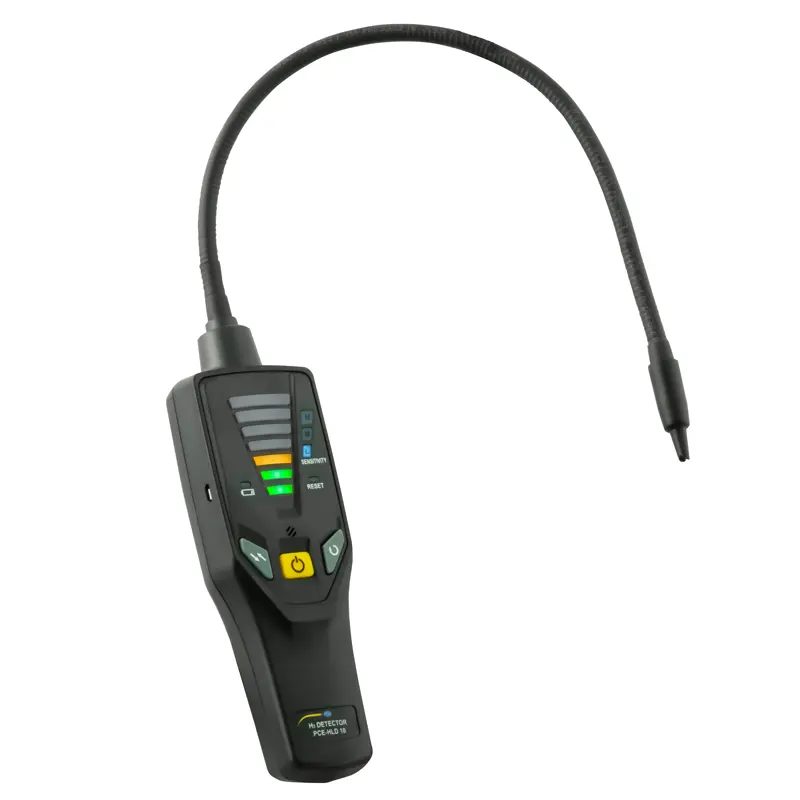
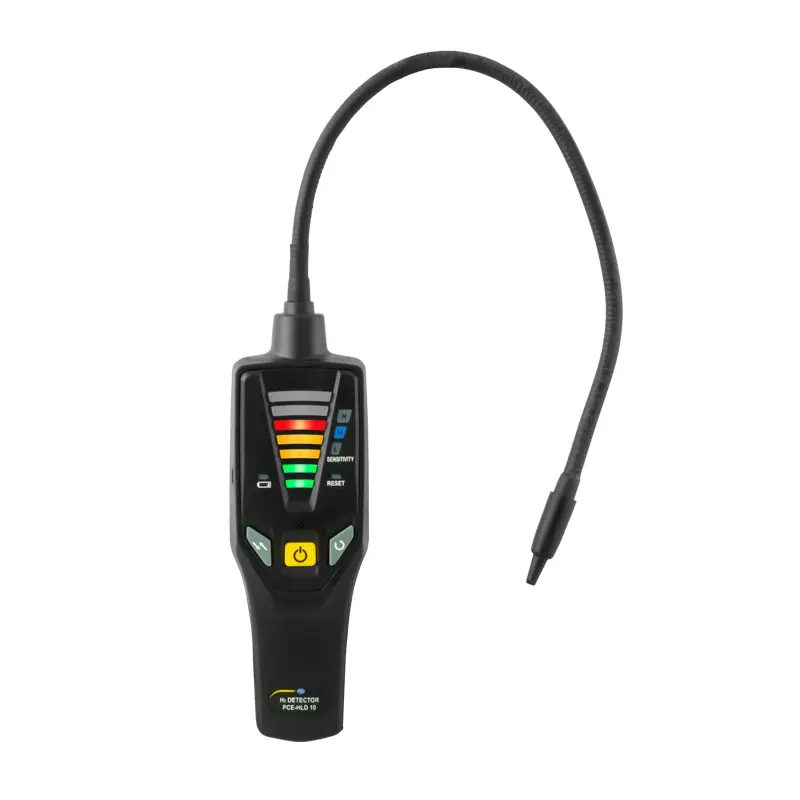
Each time it is switched on, this gas measuring device automatically records the current hydrogen concentration in the environment and then only evaluates changes related to this concentration. The reset button does the same during leak detection. If the leak cannot be clearly identified, although all the indicator LEDs are already lit, the current hydrogen concentration can be set as the base value using the reset function and the position of the leak can be better localized. The gas detector can then be reset to low output values in an unloaded environment by means of a reset.
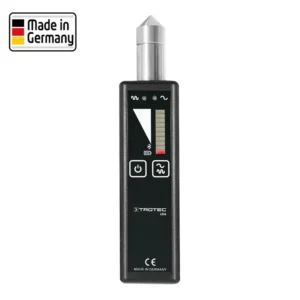
Regardless of the level of the initial concentration, one of three different sensitivity levels can be set on the gas detector at the touch of a button. The selected sensitivity is indicated by the lighting up of a labeled LED. The “H” stands for high, the “M” for medium and the “L” for low. The hydrogen content in normal ambient air is 0.5 ppm. The sensitive device already recognizes concentrations of less than 5 ppm, i.e. 0.0005 percent.
The sensor is arranged at the head of a semi-rigid 40 centimeter long hose so that it can be easily guided to the component to be tested. To search for leaks, the sensor is slowly moved as close as possible along the points to be examined. If the gas detector detects a leak, an alarm tone sounds and additional indicator LEDs light up. The higher the recorded hydrogen concentration compared to the base level, the more indicator LEDs light up.
With the four standard batteries, the Refrigerant Gauges has an operating time of around twelve hours in normal use. To save the batteries, the device shuts down after ten minutes if the automatic switch-off is activated. A control lamp shows that the batteries are low. The built-in sensor has a limited service life. Under normal conditions of use, it can be used for leak detection over a period of more than a year. Correct function can be tested regularly with test gas. If the sensor no longer reacts reliably, it can simply be exchanged for a new one.
The Refrigerant Gauges is not suitable for use in potentially explosive areas. It must therefore not be used if higher concentrations of hydrogen or other ignitable gases are to be expected in poorly ventilated areas. Above a certain concentration, hydrogen is one of the most dangerous ignitable gases because it requires little ignition energy. The lower explosion limit LEL for hydrogen is four percent.
Highlights
- Bar display with traffic light function
- Three adjustable sensitivities
- Battery life of approx. 12 hours
- Semi-rigid probe with a length of 40 cm / 15.7″
- Audible and visual alarm
- Automatic shutdown
Technical specifications
- High sensitivity>2 g (0.07 oz) / year
- Average sensitivity>15 g (0.53 oz) / year
- Low sensitivity>30 g (1.05 oz) / year
- The sensitivity refers to 5%
- Hydrogen (H2) and 95 % Nitrogen (N2)
- Alarm audible and visual: Warm-up time 45 seconds
- Alarm audible and visual — Battery: life ca. 12 hours
- Alarm audible and visual — Power supply: 4 x 1.5 V AA batteries
- Alarm audible and visual: Automatic shutdown 10 minutes
- Alarm audible and visual: Maximum altitude 2000 m / 6561 ft a.s.l.
- Alarm audible and visual — Operating conditions: 0 … 40 °C / 32 … 104 °F, <80 % RH, non-condensing
- Alarm audible and visual — Storage conditions: -10 … 60 °C / 14 … 140 °F, <70 % RH, non-condensing
- Alarm audible and visual: Hose length 40 cm / 15.7″
- Alarm audible and visual — Dimensions: 213 x 65.5 x 53.5 mm / 83.8 x 25.7 x 21.0″
- Alarm audible and visual — Weight: 400 g / 14.1 oz
Delivery scope
- 1 x Refrigerant Gauges PCE-HLD 10
- 1 x Transport case
- 4 x 1.5 V AA batteries
- 1 x Instruction manual