


Moisture problems are among the most common indoor climate issues in Estonian homes. Excessive humidity causes mold, condensation on windows, and unpleasant odors, and can damage both the building and people’s health. People often ask: How large of a dehumidifier is needed for a 100 m² house?
The short answer is: it depends on the humidity level, the ceiling height, and the intended use. In most cases, a dehumidifier with a drying capacity of 20–40 liters per day is suitable for a 100 m² home.
Why can’t you choose a dehumidifier based solely on square meters?
The operation of a dehumidifier does not depend solely on the floor surface. The following factors are also important:
- room height;
- home insulation;
- the presence of ventilation;
- population;
- drying laundry indoors;
- moisture damage or mold.
For example, a new 100 m² house with ventilation may require a significantly smaller dehumidifier than an old house of the same size where the windows condensate and there is no ventilation.
What kind of dehumidifier is suitable for a 100 m² house?
A minor moisture problem
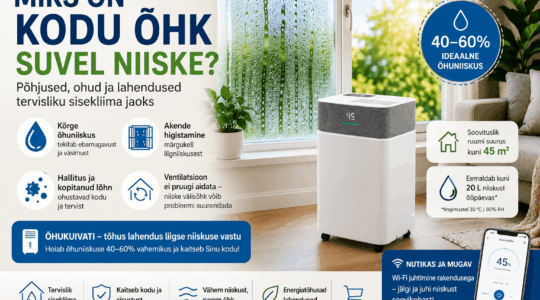
If the goal is to maintain humidity between 40% and 60% and prevent condensation on the windows:
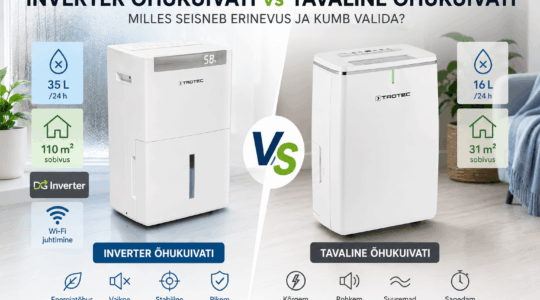
- drying capacity 20–25 l/24 h
- airflow of at least 150–250 m³/h
Suitable for:
- into apartments
- newer private homes
- to reduce seasonal humidity
Moderate moisture problem
If laundry is being dried indoors or the humidity level remains above 60%:
This is the optimal solution for most private homes in Estonia.
A serious moisture problem
If there is mold, water damage, or very high humidity:
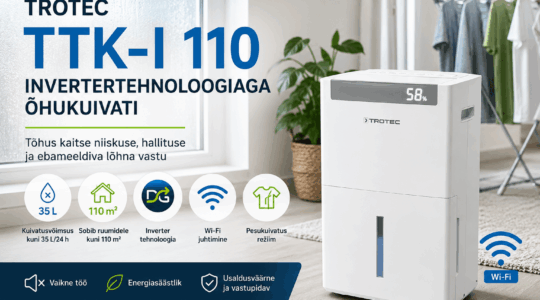
- drying capacity 40–70 l/24 h
- professional or semi-professional dehumidifier
In that case, it’s best to choose a more powerful device that will achieve the desired result more quickly.
Can a single dehumidifier dry out the entire house?
Yes, as long as the rooms are open to each other and air can circulate.
If the house has multiple stories or many separate rooms, it may be necessary to:
- leave the interior doors open;
- use a fan to circulate the air;
- Place the device in the center of the house.
In some cases, it is more effective to use two smaller dehumidifiers.
What is the ideal humidity level at home?
According to experts, the relative humidity should be:
- 40–50% in winter
- 40–60% in the summer
When humidity rises above 60%, the risk of mold, dust mites, and moisture damage increases.
Common Mistakes When Choosing a Dehumidifier
Buying a device that’s too small
Most often, people choose a dehumidifier that is too weak. The unit runs constantly but does not achieve the desired result.
Ignoring Airflow
It is not only the drying capacity in liters that matters, but also the airflow in m³/h.
Choosing an Inexpensive Device
A high-quality dehumidifier often uses less energy and lasts many years longer than the cheapest alternative.
Summary
For a 100 m² house, a dehumidifier with a capacity of 25–40 liters per day is usually sufficient. If seasonal humidity is the only issue, a smaller unit may suffice. In cases of mold, drying laundry, or moisture damage, it’s worth choosing a more powerful model.
A properly selected dehumidifier helps reduce humidity, improve indoor air quality, protect the building, and make your home healthier for the whole family.
FAQ
Is a 20-liter-per-24-hour dehumidifier suitable for a 100-square-meter house?
In some cases, yes, but in most cases, a unit with a capacity of 25–40 l/24 h is more effective.
Does a dehumidifier help prevent condensation on windows?
Yes. Removing excess moisture significantly reduces condensation on windows.
How much electricity does a dehumidifier use?
Modern household dehumidifiers typically consume 200–700 W, depending on the model and operating mode.
Does a dehumidifier help prevent mold?
A dehumidifier helps remove the moisture necessary for mold to grow, but any existing mold must be removed separately.