


When buying a dehumidifier, you’ll quickly notice that some models are equipped with inverter technology, while others use a conventional compressor. At first glance, the units may seem similar, but in reality, the compressor’s operating mode affects energy consumption, noise levels, and the unit’s ease of use.
How does a standard dehumidifier work?
A standard condensation dryer compressor operates on an “on or off” principle. When the humidity in the room exceeds the set level, the compressor starts running at full capacity. Once the desired humidity level is reached, the compressor shuts off.
This work schedule means:
- frequent switching on and off;
- major peaks in energy consumption;
- more noise at the moment of startup;
- major fluctuations in humidity levels.
In smaller rooms and for infrequent use, a standard dehumidifier is often a perfectly adequate solution.
How does an inverter-type dehumidifier work?
Inverter technology allows the compressor to adjust its operating speed based on the humidity level in the room. When humidity is high, the unit operates at a higher capacity. As the desired humidity level is approached, the compressor automatically reduces its operating capacity.
As a result:
- energy consumption decreases;
- the humidity level in the room remains more stable;
- the work is quieter;
- the compressor wears out less quickly;
- Ease of use increases.
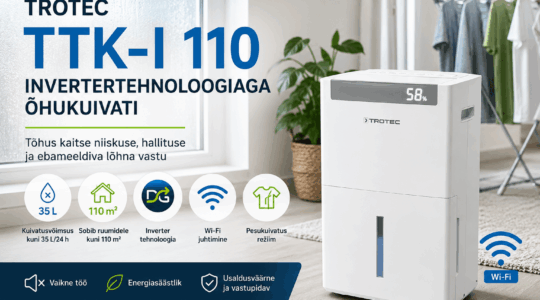
A good example is the Trotec TTK-I 110 dehumidifier with inverter technology, which automatically adjusts its power output based on the conditions in the room.
Energy Consumption Comparison
If the dehumidifier is used only occasionally, the difference in energy costs may not be very significant.
However, if:
- dry your laundry regularly;
- you’re dealing with basement moisture;
- you use the device year-round;
- you want to maintain a certain level of humidity;
In that case, inverter technology can help significantly reduce electricity costs.
Noise Level
One of the biggest differences is the noise level.
Standard dehumidifier:
- starts up abruptly;
- may be more bothersome at night;
- often operates at maximum capacity.
Inverter air dryer:
- runs more smoothly;
- keeps noise levels lower;
- is better suited for bedrooms and living spaces.
Which one should I choose?
Choose a standard dehumidifier if:
- The room is small;
- you rarely use the device;
- you want the lowest possible purchase price;
- The moisture problem isn’t a big one.
Choose an inverter-powered dehumidifier if:
- The room is large;
- you use the device every day;
- you want to reduce your energy consumption;
- you value quiet work;
- You need precise humidity control.
Is an inverter-type dehumidifier worth the investment?
Generally speaking, yes, especially in larger rooms or with long-term use. Although the purchase price of an inverter model is higher, the lower energy consumption and greater ease of use can offset that difference over time.
If you’re looking for a solution for a single-family home, a larger apartment, a basement, or a laundry room, a dehumidifier with inverter technology is often the most sensible investment.
Frequently Asked Questions
Does an inverter-type dehumidifier use less electricity?
Yes. The inverter compressor adjusts its power output as needed and prevents constant cycling on and off.
Is an inverter-type dehumidifier quieter?
Generally speaking, yes. At lower loads, the compressor runs more quietly than on a standard model.
Is an inverter-type air dryer suitable for drying laundry?
Yes. In fact, this is one of the most popular ways to use it at home.
Does inverter technology extend the lifespan of the appliance?
Usually, yes, because the compressor doesn’t have to start and stop as often.
Is an inverter-type dehumidifier worth it for a small apartment?
Not always. In small rooms, a high-quality standard dehumidifier may be a sufficient and more affordable solution.