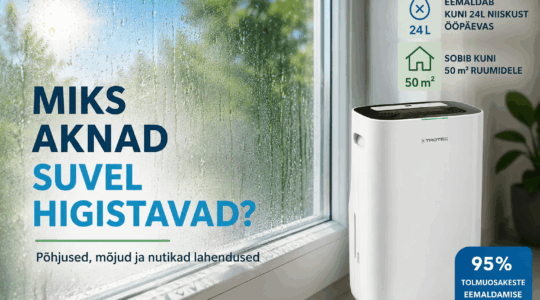



Many people associate humidity problems with fall and winter, but in fact, the air in your home can become uncomfortably humid even in the summer. High humidity makes rooms feel stuffy, causes windows to fog up, and can promote mold growth over time.
Why does humidity rise in the summer?
In the summer, outdoor air often contains a lot of moisture. If you open windows or if the ventilation system brings moist outdoor air into the room, the relative humidity can quickly rise above the recommended level.
The following also contribute to humidity:
- drying laundry indoors;
- taking a shower;
- food preparation;
- inadequate ventilation;
- basements and cooler rooms.
What is a normal level of humidity at home?
The ideal relative humidity is between 40% and 60%. If the humidity level consistently rises above 60%, the risk of mold, dust mites, and unpleasant odors increases.
If you want to monitor humidity levels, check out Pro Air OÜ’s selection of measuring instruments:
👉 https://proair.ee/tootekategooria/mooteriistad/
How can you tell if there’s too much moisture?
Signs of excessive moisture may include:
- condensation on windows;
- mold stains on the walls;
- a musty smell;
- damp clothes and bedding;
- Stuffy, stuffy indoor air.
If you notice these symptoms, you should measure the humidity in the room using a hygrometer or a humidity meter.
Does ventilation help?
Proper ventilation helps remove excess moisture, but the situation can be more complicated in the summer. If the outside air is humid, ventilation can actually bring more moisture indoors.
Learn more about Pro Air OÜ’s heat recovery ventilation solutions:
👉 https://proair.ee/tootekategooria/rekuperaatorid/
See also:
👉 https://proair.ee/kas-rekuperaator-aitab-niiskuse-vastu/
When do you need a dehumidifier?
If the humidity level is consistently above 60%, the most effective solution is a dehumidifier.
A dehumidifier helps:
- reduce the risk of mold growth;
- speed up the drying of laundry;
- improve the indoor climate;
- remove excess moisture after water damage;
- reduce condensation on windows.
View all Pro Air OÜ air dryers:
👉 https://proair.ee/tootekategooria/ohukuivatid/
Basements and water damage require a more effective solution
If you’re dealing with water damage in a basement, garage, or elsewhere, you may need a professional construction dehumidifier.
Check out our selection of construction dehumidifiers:
👉 https://proair.ee/tootekategooria/ehituskuivatid/
How do you measure humidity?
A simple moisture meter can help you quickly determine whether the problem is actually caused by excess moisture.
We recommend:
👉 Trotec BM31 Moisture Meter
https://proair.ee/toode/materjali-ja-ohuniiskuse-mootur-bm31/
Summary
Summer moisture problems are surprisingly common in Estonia. If the air in your home feels stuffy, the windows are fogged up, or you notice a musty smell, it’s a good idea to check the humidity level. Proper ventilation, regular monitoring, and, if necessary, a high-quality dehumidifier help maintain a healthy indoor climate and protect both the building and the health of its occupants.
Is the humidity too high in your home?
Pro Air OÜ can help you choose the right solution.
➡ Dehumidifiers: https://proair.ee/tootekategooria/ohukuivatid/
➡ Heat recovery units: https://proair.ee/tootekategooria/rekuperaatorid/
➡ Measuring instruments: https://proair.ee/tootekategooria/mooteriistad/
➡ Construction dehumidifiers: https://proair.ee/tootekategooria/ehituskuivatid/
FAQ
Is high humidity harmful to your health?
Yes. Excess moisture promotes the growth of mold and dust mites, which can cause allergies and respiratory problems.
Does the heat recovery unit remove moisture?
A heat recovery unit helps with air exchange, but it does not replace a dehumidifier in situations where humidity levels are high.
Does the dehumidifier work in the summer, too?
Yes. In fact, dehumidifiers are often used in the summer, when the outdoor air is very humid.
Which dehumidifier is best for an apartment?
In most cases, a dehumidifier with a capacity of 10–25 l/24 h is sufficient, but the choice depends on the size of the room and the humidity level.
How quickly does a dehumidifier reduce humidity?
Depending on the room and the unit’s capacity, the humidity level may drop to the desired range within a few hours to a couple of days.