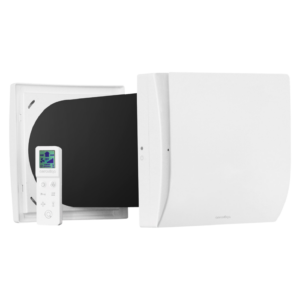


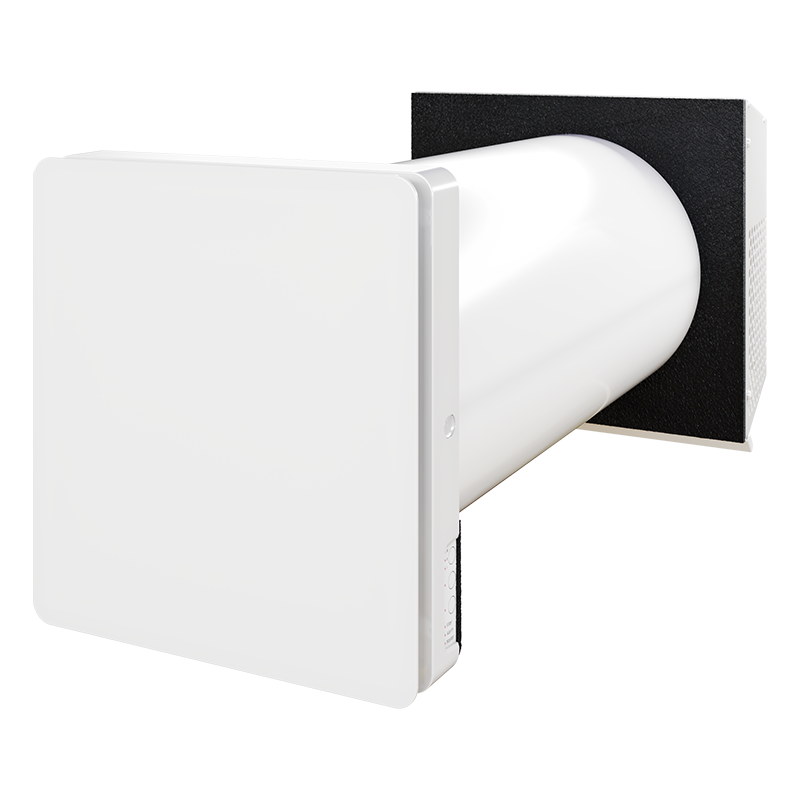



Blauberg AirOne HRV – local heat recovery ventilation unit
Blauberg AirOne HRV is a modern local supply and exhaust ventilation unit that ensures continuous controlled air exchange in the room and uses the heat of the extracted indoor air to preheat the fresh outdoor air.
AirOne HRV is well suited for private homes, apartments, bedrooms, living rooms and home offices where efficient ventilation is desired without the need for a ventilation duct running through the entire building.
Unlike a simple exhaust fan, AirOne both injects fresh air and exhausts used indoor air. The air flows pass through a heat exchanger, through which the thermal energy of the outgoing air is transferred to the incoming fresh air.
Why choose AirOne PRC?
HRV stands for Heat Recovery Ventilation.
The primary function of the AirOne HRV is to reduce heat loss associated with ventilation. In the winter, the energy from the warm exhaust air is used to preheat the cold outside air, but moisture is not actively recovered.
This makes the HRV version a good choice, especially in homes where the following are desired:
- a constant supply of fresh air;
- reduce high CO₂ levels;
- remove excess moisture;
- reduce condensation on windows;
- improve bedroom ventilation;
- reduce heat loss associated with ventilation;
- avoid the construction of bulky ventilation ductwork.
HRV helps remove excess moisture
The AirOne HRV is particularly well-suited for situations where high humidity is a problem in the home.
Moisture is generated on a daily basis from breathing, washing, cooking, drying laundry, and other activities. If ventilation is inadequate, this moisture remains inside the building and can cause windows to fog up and lead to condensation.
HRV ventilation removes humid indoor air and replaces it with fresh outdoor air.
Heat recovery reduces energy loss
When we ventilate by opening a window in the winter, we lose the energy used to heat that air along with the air that escapes.
The purpose of heat-recovery ventilation is to recover a large portion of that energy before the air leaves the building.
Therefore, the AirOne HRV allows for continuous ventilation of the room without the need to rely on opening windows as the primary ventilation method.
Works well in a bedroom
CO₂ concentrations in the bedroom can rise rapidly overnight, especially in new and renovated airtight buildings.
The AirOne HRV continuously brings fresh outdoor air into the bedroom and removes CO₂ and moisture produced by human respiration.
This makes local heat-recovery ventilation a good solution even when the problem is limited to just one or two rooms.
When should you choose an HRV instead of an ERV?
You should choose the AirOne HRV if:
- your home tends to be too humid;
- you want to remove moisture as effectively as possible;
- condensation forms on the windows;
- your main goal is heat recovery;
- dry indoor air in the winter isn’t a major concern.
However, if your home becomes too dry in the winter due to ventilation, you should consider the AirOne ERV model.
AirOne HRV Technology
| Feature | AirOne HRV |
|---|---|
| Ventilation Type | supply + exhaust |
| Heat Recovery | Yes |
| Moisture Recovery | No |
| Heat Exchanger | HRV |
| Fresh Air Inlet | Yes |
| CO₂ Removal | Yes |
| Removing Excess Moisture | Yes |
| On-site installation | Yes |
| Plumbing for the entire house is required | No |
| Suitable for a private home | Yes |
| Suitable for an apartment | Yes |
| Perfect for the bedroom | Yes |
Frequently Asked Questions
What is HRV ventilation?
HRV, or Heat Recovery Ventilation, refers to ventilation with heat recovery. The heat from the exhaust air is used to warm the incoming fresh air.
Does an HRV recover moisture?
The purpose of a standard HRV heat exchanger is to recover heat, not moisture. If you also want moisture recovery, you should choose the ERV version.
Does the AirOne HRV help with high CO₂ levels?
Yes. Ventilation removes stale indoor air and replaces it with fresh outdoor air.
Is the AirOne HRV suitable for a house undergoing renovation?
Yes. One of the main advantages of a localized solution is the ability to improve ventilation in specific rooms without having to install a ventilation duct system throughout the entire house.
Should I choose an HRV or an ERV?
If the problem is excessive humidity, an HRV is often the logical choice. If a well-ventilated home becomes too dry in the winter, it’s worth considering an ERV.