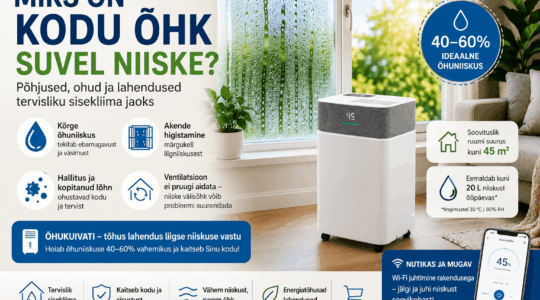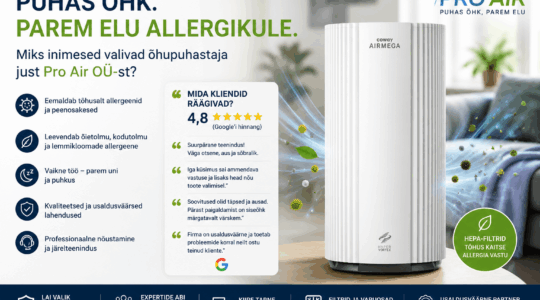



Pro Air OÜ air purifiers operate quietly but have a high air purification capacity, for which there are currently no alternatives on the Estonian market. The Tartu City Government tested the noise levels and efficiency of our equipment—which is why they chose Pro Air OÜ’s equipment.
www.proair.ee
ERR
Editor: Merili Nael
Source: “Aktuaalne kaamera”
One-third of schools in Estonia still lack forced ventilation, and there are problems ensuring good air quality. The government recommends designing and installing forced-ventilation systems in school buildings, but some local governments, as fall approaches, also see a need for more affordable air purifiers that can be put into use more quickly.
A few months ago, Tartu Karlova School received air purifiers equipped with HEPA filters, as the school lacks the forced ventilation necessary to ensure air quality. Although the air purifiers installed at the school do not help reduceCO2 levels, the city of Tartu estimates that they will most likely be put into use by the start of the next school year.
Compared to installing a room-based ventilation system or a complete ventilation system—which often requires building renovations—installing air purifiers takes less time and is also more cost-effective.
“The problem with a room-based solution is that it is relatively expensive per room. It is at least ten times more expensive than installing an air purifier in that same classroom, and manufacturing them will likely take time as well. Air purifiers are a standard solution that have been in production for years and are the quickest way to solve this problem,” explained Tartu Mayor Priit Humal.
A good ventilation system reduces the risk of students contracting COVID-19 by several times
So far, the city has been debating which models are best suited for the school system and how effective they are. Although installing a ventilation system would be the most effective solution, studies by the University of Tartu confirm that the use of air purifiers in school buildings also helps prevent the spread of viruses.
“Of course, this isn’t an ideal solution, but during an epidemic, it could be a solution for schools with poor ventilation. The best ones use HEPA filters, and there are also additional filters that remove odors and smells. How often they need to be replaced is one question, but they are safe in the sense that they do not release new chemicals into the air,” explained Heikki Junninen, a professor of environmental physics at the university.
Although cleaning the filters is a hassle, air purifiers have proven their worth, according to Karlova School. Their use has not led to a significant increase in costs.
“There are currently 65 air purifiers at the school, and as far as I’ve been tracking the bills from February until now, the costs haven’t gotten too high— not by any significant amount,” said the school’s financial manager, Svetlana Jasnova.
Installing air purifiers in both schools and kindergartens by fall would cost the city of Tartu nearly three million euros. The City of Tartu hopes to determine the number of air purifiers that can be purchased and the total cost by the first half of the summer. The state has no plans to allocate additional funds for the purchase of air purifiers.