Living with a Pollen Allergy: Can You Ease Symptoms at Home and at Work?
The sun is shining brighter, birds are returning home from the south, and nature is coming to life. Many people rejoice at the start of spring, while others are bracing themselves for a difficult period due to their allergies. Nearly one in six people in Europe suffers from pollen allergies.
Pollen allergy most commonly manifests as pollinosis, also known as hay fever, which can cause reactions in the eyes, nose, and bronchial tubes to pollen. Symptoms of pollinosis include, for example, red, itchy, and watery eyes; a profuse runny nose and sneezing; wheezing characteristic of asthma; and a cough. In Estonia, approximately 10% of the population suffers from pollinosis.
During an attack, various symptoms may occur, such as a runny nose, sneezing, red, itchy, or watery eyes, and swelling around the eyes. These symptoms may worsen depending on weather conditions and the living environment. On dry, windy days, there is a lot of pollen in the air. On rainy days, pollen tends to settle on the ground and has less of an effect on hay fever sufferers.
Air pollution levels in Estonia’s major cities are as follows:
Pollen
SO2 – carbon dioxide – carbonic acid gas
NO2—nitrogen dioxide
CO – carbon monoxide
O3 – ozone
NMHC – non-methane hydrocarbons
NH3 – ammonia
H2S – hydrogen sulfide
Hg – mercury
C6H6 – benzene
C7H8 – toluene
C8H10 – ethylbenzene
TSP – total suspended particulates
PM10 – fine particulate matter
PM2.5 – ultrafine particles
In addition, air quality has deteriorated over the years. The concentration of particulate matter in the air has increased, and the chemical composition of our air has changed. This, in turn, impairs nature’s ability to reduce pollen in the air. Pollen remains in the air, and we end up breathing in more of it.
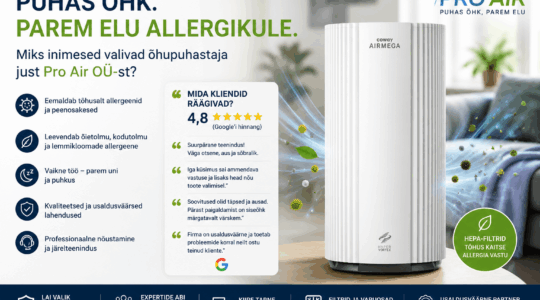
The outdoor environment is largely beyond our control; however, we can control our indoor environment. It is well known that indoor air quality is 5 to 30 times worse than outdoor air quality. The True HEPA filter, included in all Coway air purifiers, removes 99.97% of all particles, pollen, and allergens so you can enjoy clean, healthy air at home. This helps reduce our reliance on medications, which always come with side effects.
Indoor Air Pollution
We spend most of our time indoors—at home, at work, in stores, and so on. At the same time, we have the ability to turn our homes and offices into spaces with clean air, which means we would spend most of our time in a healthy environment. In Sweden, Denmark, and Norway, most daycare centers, schools, homes, and offices are already equipped with air purification systems. This is because people have become aware of the issue, and the government has implemented awareness campaigns regarding the health implications of indoor air pollution.
Awareness has already grown in Estonia; many companies rent equipment from us, such as humidifiers and air purifiers. Smaller companies usually purchase their own equipment. The reason is simple—in large companies, people don’t have time to deal with equipment maintenance and cleaning. They simply outsource this service to us. This way, they can focus on their core business, and the equipment doesn’t appear on their balance sheet.
In this way, companies create an environment in their offices where people with allergies or asthma can work. It also reduces the risk of illness in these spaces, as pathogenic bacteria and viruses are filtered out of the air, and the risk of infection is lowered—which is especially important in areas where many people gather. This helps companies keep their employees at work, which in turn increases the company’s revenue.
Air purifiers are also capable of removing formaldehyde and other organic compounds—which are carcinogenic and can cause cancer—from the air emitted by office furnishings. People who are more sensitive to odors can also stay in a room where an air purifier is operating, since activated carbon binds to odor-causing substances and makes the air in the room neutral and less irritating.
Air humidification, however, makes people feel better and reduces the risk of upper respiratory tract infections, as the mucous membranes retain their natural moisture, making bacteria and viruses less harmful.