Clean air shouldn’t be a luxury, but a natural part of our lives. So today, we’re going to talk about how to improve air quality.
We breathe about 20,000 times a day, inhaling 12,000 (12 cubic meters) liters of air. Much of this air intake takes place in the great outdoors. In fact, we spend an average of 90% of our time indoors, where air quality is at its worst!
According to a study conducted in 2011 by the Faculty of Medicine at the University of Tartu, ultrafine particles in outdoor air in Estonia are estimated to cause an average of 600 premature deaths per year.
Since the currently permitted minimum concentrations of fine particulate matter have been found to have a negative impact on human health, both the World Health Organization and leading scientists in the field recommend limit values for PM10 that are twice as strict.
If we compare these values with current pollution levels in Tallinn, the PM10 and PM2.5 limits would be exceeded not only in the city center but also in larger residential areas. However, since many countries would be unable to meet this requirement by 2010, an amendment to this directive is currently under discussion in the European Parliament, which is, of course, regrettable from a public health perspective.
Indoor air is just as polluted as outdoor air
One cubic meter of indoor air can contain up to 20 million particles (dust, fine dust, allergens, bacteria, pollen, fungi, viruses, etc.). That is up to twenty times more than at a crossroads outdoors and up to two hundred times more than at sea.
The situation worsens even when the rooms are heated indoors during the winter, which significantly reduces humidity. These factors have a strong negative impact on our health.
How can we improve air quality?
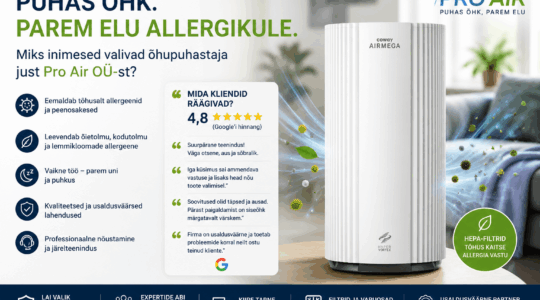
Air purifiers and humidifiers are highly effective tools for creating optimal indoor conditions and promoting health. Using an air purifier is effective against fine particles, microorganisms, volatile substances, unpleasant odors, and allergens.
Air Purification in Practice
Effective air purification is more than just filtering out air pollutants. Ideal air purification is combined with humidification, and it is important to use a high-quality HEPA filter.
Volume of filtered air (airflow capacity per hour) Minimizing pollution sources, proper placement of the air purifier, and the humidity level in the room are the main factors to consider when using an air purifier.
Healthier Air
The air we breathe every day contains more and more harmful substances. (Fine) dust, pollen, (tobacco) smoke, viruses, fungi, bacteria, and allergens cause allergic reactions and respiratory diseases. The U.S. Environmental Protection Agency (EPA) classifies indoor air pollution as one of the five greatest environmental risks affecting human health.
The number of people suffering from allergies has risen sharply as indoor air pollution levels have increased. One in three people suffers from allergies today. These trends also affect the economy; more than 30% of sick leave is caused by respiratory problems.
Air Purification Methods
There are many different types of air purifiers available, but they can generally be classified into three main categories:
HEPA Air Purifiers
The best-known and most effective air filtration system is an air purifier with a HEPA filter. A HEPA filter removes at least 99.97% of particles as small as 0.3 micrometers (0.0003 mm). This particle size is known as the Most Penetrating Particle Size (MPPS) or the hardest-to-filter particle size.
To increase the effectiveness of removing odors and volatile organic compounds (chemicals, VOCs), these air purifiers often include an activated carbon filter. HEPA air purifiers are also available with a humidifier. Since HEPA air purifiers generally have the highest airflow, their effectiveness is noticeable immediately after they are placed in a room.
Plasma/Ionizer Air Purifiers
This may include various types of air purifiers, such as ionizers, photocatalytic air purifiers, and air purifiers with electrostatic filters, these devices typically operate without filters, or filters are used only as pre-filters to remove coarse dust particles from the air.
Photocatalytic air purification works by exposing a catalytic surface to UV light, where the catalytic material reacts to the UV light, creating unstable molecules that disperse in the air, breaking down harmful substances and killing microorganisms and allergens.
We use these devices in ventilation systems.
Air Washers
The third method is air washing, in which the drawn-in air is ionized, causing the air particles to acquire a static charge; the air is then directed through humidification filters consisting of rotating discs placed in a water tank.
As a result of ionization, dust particles adhere to the humidification plate, which is then cleaned again with water. The pollutants end up in the water, and the moisture is released into the room where the device is located. This means that the air is filtered and humidified. In terms of efficiency, the air washer is one-third as effective as air purifiers with HEPA filter systems.
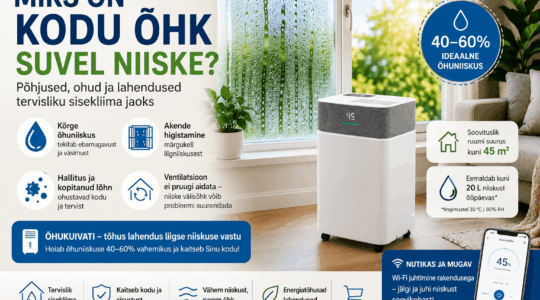
Why is the right humidity level important?
Humidity is usually expressed as relative humidity—that is, as a percentage of the maximum amount of water vapor that the air can hold at a given temperature and pressure at that moment.
Indoor humidity can be too low in both winter and summer. In winter, humidity levels are particularly low because rooms are heated and outdoor humidity is already low during cold weather. The humidity in air cooled by an air conditioner is very low and can therefore cause health problems or discomfort in the summer.
The wood used in furniture, hardwood floors, and musical instruments can be damaged or warped when humidity levels are low. If the humidity is too low, tropical plants such as palm trees will dry out.
Various studies have shown that airborne viruses (such as the influenza virus) can persist longer in rooms with low humidity. The fact that the influenza virus is highly seasonal can be explained by the much lower humidity levels in winter.
Studies by the Indoor Air Quality Association (IAQA) show a link between humidity and absenteeism. It was found that when humidity drops below 40%, absenteeism increases sharply.
The best indoor solutions are a combination of air purifiers and humidifiers, which means that the air is purified, then directed through a water filtration system—which has already purified the water—and the purified and humidified air is released into the room.
COWAY currently offers the best solutions for this purpose; its product line consists exclusively of health-related products, and the company relies on the expertise of scientists in the development of its products and technologies.
Problem – Analysis – Research – Solutions.
3,800 intellectual property rights, 1,800 patents, and 370 researchers working at the Coway Research and Development Center, which was founded in 1993. Research and development activities are primarily focused on ensuring customer satisfaction and consumer convenience.
It’s that simple!
Jaanus Liba / Pro Air OÜ