

Do you know what you’re breathing, or what the indoor air quality is like at home or at the office?
Volatile organic compounds and PM2.5 particles are the most harmful elements and are the root cause of many diseases. They originate from many sources: transportation, industrial activity, waste incineration, and other human activities, but natural events can also play a significant role.
Indoor air is 5 to 20 times more polluted than outdoor air. Most people are unaware of the harm caused by air pollution. However, those who suffer from respiratory problems, allergies, and certain heart conditions are aware of it. They pay close attention to what they consume or breathe. Factors contributing to indoor air pollution can range from pet dander, cigarette smoke, and pollen to elements such as PM2.5 and volatile organic compounds, which can have deadly consequences!
What is it that causes so much harm to our bodies?
PM2.5 refers to atmospheric particles (PM) with a diameter of less than 2.5 micrometers that can only be detected using an electron microscope. They are typically found as combustion particles in vehicle exhaust, organic compounds, and similar sources. Another variant of PM2.5 is PM10, i.e., solid particles with a diameter of less than 10 micrometers, which are found in the form of pollen, dust, mold, etc. Because they are very small and lightweight, these particles remain suspended in the air for extended periods, significantly increasing the likelihood of inhalation through both the nose and the mouth. Studies show that fine particulate matter triggers or exacerbates chronic conditions such as asthma, bronchitis, heart attacks, and many other health problems that can be fatal if preventive measures are not taken. Young children and older adults are the groups most at risk.

The American Heart Association considers PM2.5 to be the most significant health risk associated with air pollution.
Exposure to PM with a diameter of less than 2.5 μm (PM2.5) over a period ranging from a few hours to a week can lead to cardiovascular-related mortality and nonfatal events; long-term exposure increases the risk of cardiovascular mortality to an even greater extent than exposure over a few days and reduces life expectancy by several months to a few years among population groups at higher risk. “
Volatile organic compounds (VOCs) are substances that can easily evaporate. Solvents, paints, thinners, adhesives, disinfectants, air fresheners, pesticides, varnishes, furniture, building materials, etc., are sources of VOCs indoors. Volatile organic compounds enter the body through two routes: inhalation and skin contact. In the short term, symptoms of exposure to these substances may include irritation of the eyes and respiratory tract, headaches, dizziness, etc. However, long-term exposure can cause nausea, fatigue, liver and kidney damage, and central nervous system damage; in some cases, it can even lead to cancer.
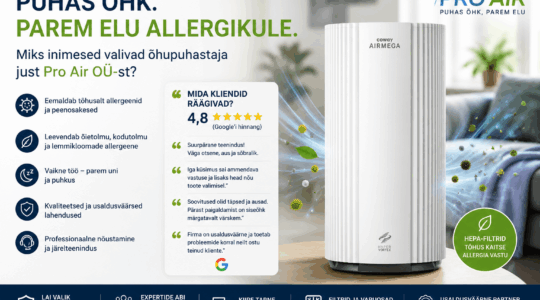
Now that you have a brief overview of the two main indoor air pollutants and their effects, wouldn’t it make sense to take preventive measures to neutralize and purify the air in your home, office, or any other indoor space? And what could be better than investing in a device that delivers immediate results, such as a Coway air purifier? Its patented multi-layered anti-flu HEPA filter removes microbes, bacteria, and allergens with 99.97% efficiency. The patented urethane charcoal filter helps draw in fresh air while absorbing unpleasant odors, smoke, and more. Join our “Healthy Indoor Spaces” revolution and fight indoor air pollution!
If you would like more detailed information, please email us at info@proair.ee or contact us through our website at https://proair.ee/kontakt
Jaanus Liba
Pro Air OÜ