Droplet infections are infections transmitted by pathogens—such as viruses, bacteria, fungi, and others—that are carried in the air as small droplets or settle on surfaces (viruses, bacteria, fungi, etc.). Droplet infections spread when, as a result of an infected person coughing, sneezing, speaking, or breathing, viral particles are released into the air or onto surfaces in the form of saliva or other droplets.
Reducing aerosols in the air is important to prevent air pollutants, viruses, bacteria, mold spores, and fungal hyphae from entering our respiratory tracts. Chemicals, combustion byproducts, and other substances also spread through the air as aerosols.
Respiratory infections spread primarily through droplets and fluids produced when coughing, sneezing, talking, or breathing. Viral particles can be transmitted to surfaces or people in their path, depending on the size of the particles, air temperature, and humidity. The size of moisture particles generated by an average sneeze varies between 72 and 386 µm in diameter, and the finest of these can remain suspended in the air for at least 4 hours under suitable conditions. Although individual virus particles are many times smaller than such moisture droplets (for example , the coronavirus that caused the 2020 the coronavirus that caused the 2020 pandemic has a diameter in the range of 0.05–0.2 µm), viruses do not usually spread individually but rather in larger clusters, which in turn are contained within the larger moisture particles mentioned above. Therefore, compared to an uncovered face, any respiratory protection with a filter density sufficient to capture moisture particles offers protection against droplet transmission. Protective goggles ora face shield are usually necessary as well. The disease can be transmitted as a result of contact with an infected person, animal, or surface if viral particles enter the mucous membranes of another person—for example, through the mouth, eyes, nose, or ears.
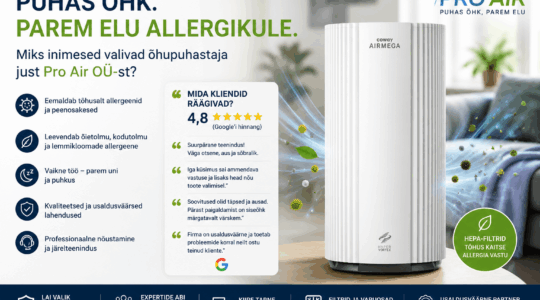
Infection does not occur automatically upon inhaling the virus or through contact with mucous membranes. Infection is prevented if the number of viral particles is too small or if a person’s overall immune system is strong enough. Good ventilation is effective for reducing the number of viral particles. An air purifier provides an additional significant benefit, as its filtration capacity in cubic meters is usually greater than that of an office’s supply ventilation system. More powerful air purifiers, such as the Coway Storm, can remove aerosols from the air at a rate of approximately 500 m³ per hour. If your office has an area of 100 m² and a ceiling height of 2.5 m, then one air purifier can filter the air in that room up to two times within one hour.
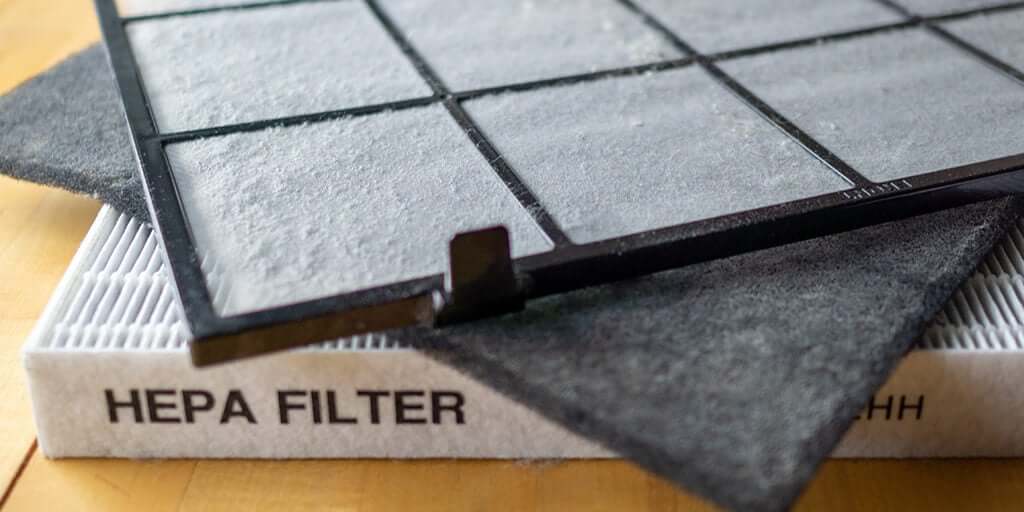
Coway devices feature a tested and certified filter system that removes aerosols, VOCs, TVOCs, allergens, mold spores, as well as viruses and bacteria from the air.
If you have any questions or need advice on choosing an air purifier, please contact us at info@proair.ee or call 533 222 58.
Jaanus Liba
Pro Air OÜ