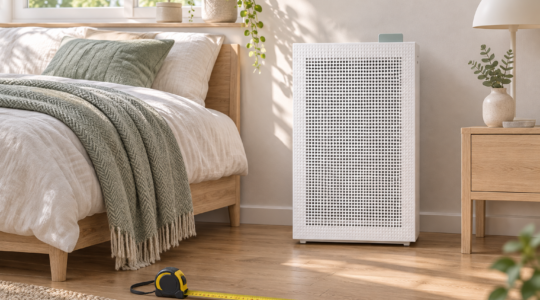


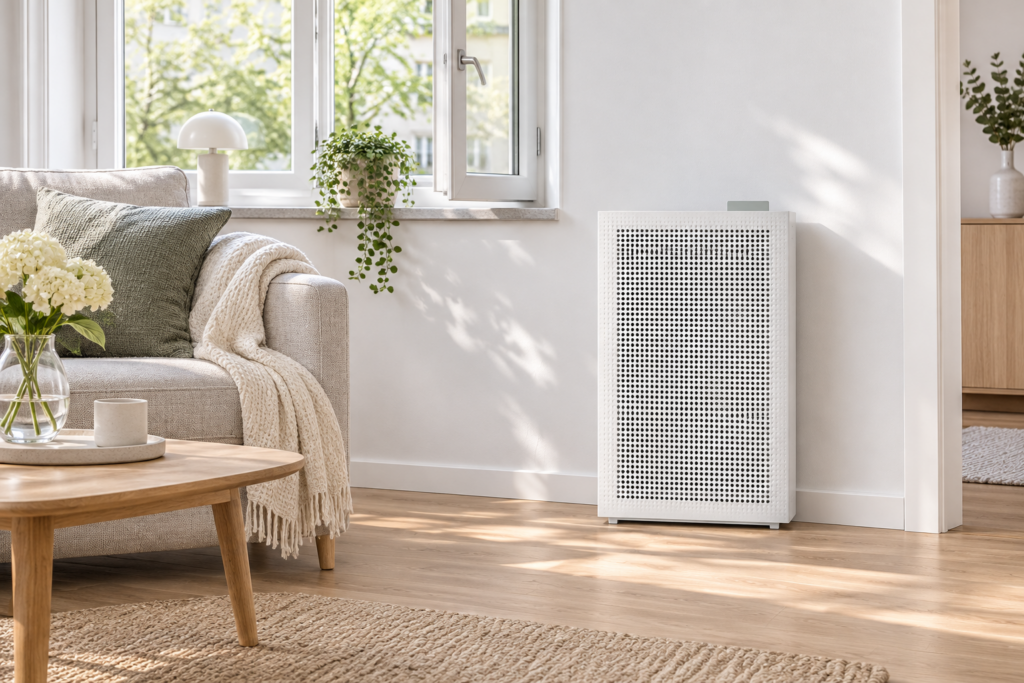
During the first few months after moving into a new or newly renovated home, indoor air quality is often significantly worse than in an older property. The culprit is the building and finishing materials themselves: composite boards, paints, varnishes, sealants, adhesives, and flooring constantly release volatile organic compounds (VOCs) and formaldehyde. This chemical off-gassing reaches its peak during the initial weeks before tapering off over several months.
Tackling this problem requires a clear, three-tiered hierarchy of action: eliminate the source, ventilate aggressively, and only then filter. An air purifier cannot replace mechanical ventilation or regular airing out, because standard HEPA filters trap airborne particles, not gases. Testing indoor air can help you track your progress, but a single snapshot never tells the whole story.
| Source | Primary Emissions | Recommended Action |
|---|---|---|
| Particleboard, plywood, MDF (kitchen cabinets, shelving, subflooring) | Formaldehyde | Choose low-emission materials, allow items to off-gas before installation, and ensure steady, continuous ventilation |
| Paints, varnishes, sealants | VOCs (peaking during application and the first few days of drying) | Maximize ventilation during application and for at least 72 hours afterwards |
| Adhesives, floor coverings | VOCs, semi-volatile organic compounds (SVOCs) | Select products certified to EMICODE EC1 or Finnish M1 standards |
| Sanding, demolition | Fine dust and particulates | Seal off work areas, use wet-sanding methods, and run a HEPA air purifier during cleanup |
What Gets Released into the Air in a New Home and How Long It Lasts
Formaldehyde is the most widespread and stubborn indoor pollutant in newly built spaces. In residential settings, it primarily off-gasses from engineered wood products bonded with urea-formaldehyde resins, such as particleboard, plywood, and medium-density fibreboard (MDF). These materials are standard in kitchen cabinets, built-in wardrobes, interior doors, and subfloors. Paints, varnishes, glues, wallpapers, and synthetic carpets can also release formaldehyde. Because you cannot realistically test every single board or piece of trim in your home, evaluating materials by product category is the most practical strategy.
Fortunately, time is on your side. According to the US Environmental Protection Agency (EPA), formaldehyde emissions typically peak within the first year, declining substantially in the months and years that follow. Field studies on newly built and renovated spaces show that total volatile organic compound (TVOC) levels drop dramatically in the first month, followed by a steadier, long-term decline. In research tracking high-emission buildings, TVOC levels dropped by up to 97% within three months, while buildings with lower baseline emissions saw reductions of around 73%. Still, reaching a stable, permanent baseline can take two years or more.
Indoor temperature directly affects the speed of off-gassing: heat and radiant underfloor heating accelerate the release of chemicals from building materials. As a result, measurements taken in the same room on a warm, sunny summer afternoon will be significantly higher than those taken in early spring.
What the Limits and Standards Say
In Estonia, there are currently no standalone national statutory limits for residential formaldehyde levels. In practice, health authorities rely on the World Health Organization (WHO) guideline: concentrations should not exceed 0.1 mg/m³ over any 30-minute period. Keeping levels below this threshold prevents sensory irritation, such as stinging or burning in the eyes, nose, and throat.
At the manufacturing level, the European Union has introduced stricter regulations. Under Entry 77 of Annex XVII to the REACH Regulation, furniture and wood-based articles placed on the EU market after 6 August 2026 must ensure that formaldehyde emissions do not exceed 0.062 mg/m³ under standard test chamber conditions. This requirement cuts the long-standing European E1 standard (0.124 mg/m³) in half. However, because this rule applies strictly to newly manufactured and marketed goods, older retail inventory and second-hand furniture may not meet these tighter limits. Always check the emission classification with the manufacturer or supplier.
Source Control: Before, During, and After Renovation
Source control is the single most effective and economical way to protect your indoor air: any pollutant you prevent from entering your home is one you never have to remove later.
Material selection. Prioritize products with independent, lab-tested emission certifications. The EMICODE EC1 label denotes “very low emissions” for flooring adhesives, grouts, and construction chemicals. In Northern Europe, the Finnish M1 certification confirms that materials meet stringent emission thresholds for VOCs, formaldehyde, and ammonia, alongside an olfactory acceptability test. For paints and varnishes, look for reliable marks like the EU Ecolabel or Blue Angel, which certify low solvent and VOC content. As the M1 guidelines point out, however, low-emission materials are never a substitute for adequate ventilation.
Installation sequencing. Wet finishing products—paints, varnishes, and floor adhesives—release the vast majority of their volatile solvents during the first few days of drying. Complete all painting, lacquering, and sealing before moving in upholstered furniture, mattresses, or soft textiles. Porous fabrics act like sponges, absorbing airborne VOCs and slowly re-emitting them into your living space for months. The EPA also recommends unboxing high-VOC furnishings outdoors or in an open garage to let them off-gas for a few days before bringing them inside.
Ventilation during renovation. The EPA advises maintaining maximum airflow while applying wet finishes and for at least 72 hours afterwards. Placing a window-mounted exhaust fan in the work area to blow air outdoors creates negative pressure, which pulls fumes out directly while preventing airborne vapours from migrating into the rest of the home.
Dust containment. Fine dust from drywall sanding, tile cutting, and demolition travels fast. Seal off interior doorways and HVAC vents with plastic sheeting, mist surfaces with water before scraping or wet-sand where possible, and keep children and pets away from active work zones.
Ventilation and Filtration Are Not the Same Thing
Ventilation and air filtration are often treated as interchangeable, but they perform fundamentally different jobs. Ventilation introduces fresh outdoor air, diluting all indoor pollutants at once—including VOCs, formaldehyde, carbon dioxide, and excess moisture. Filtration simply recirculates the air already inside the room, capturing only the specific pollutants that its internal media is designed to catch.
Ventilation: How Much Fresh Air Do You Need?
Estonia’s minimum energy performance regulations require an outdoor airflow rate of at least 0.42 l/(s·m²) of heated floor area when designing new or thoroughly renovated detached homes. The same 0.42 l/(s·m²) benchmark applies to individual apartments with dedicated ventilation controls. For a standard 60 m² apartment, that calculation works out to: 60 × 0.42 = 25.2 l/s, or roughly 91 m³/h. Remember that this figure is a regulatory minimum for energy compliance, not an upper limit for optimal air quality. During the initial months—and especially right after painting or fitting cabinetry—you should run your ventilation well above this baseline.
Ventilation dilutes airborne pollutants, but it does not speed up the natural off-gassing rate of solid, cured materials. The exception is wet applications like wet paint, where air movement accelerates drying. Opening windows for an aggressive 24-hour cross-breeze will not permanently strip VOCs out of cabinets or engineered wood floors. Steady, continuous air exchange is vastly superior to airing out a room once or twice a day.
During a Northern European winter, bringing in fresh outdoor air around the clock can cause substantial heat loss. A heat recovery ventilation system solves this by extracting thermal energy from stale exhaust air and transferring it to the incoming fresh stream. If an existing home lacks central ductwork, decentralized systems are an ideal retrofit option; you can explore suitable heat recovery ventilation units to find the right configuration. A single through-wall unit manages an individual room or zone, whereas whole-home airflow requires paired units or a fully ducted system.
The Blauberg AirWall is a decentralized heat recovery ventilator that delivers airflow rates of up to 150 m³/h, available in both HRV and ERV configurations. It is engineered specifically for rooms without central mechanical ducting, though multiple units are required to balance airflow across an entire apartment.
Filtration: What an Air Purifier Can and Cannot Do
A standard HEPA filter is engineered to capture airborne particles: construction dust, pollen, pet dander, and smoke. Because VOCs and formaldehyde are gases, they pass straight through HEPA fibers unimpeded. Capturing gases requires an adsorbent filter, usually containing activated carbon. According to the EPA guide on residential air cleaning, choosing a purifier with an activated carbon filter to target gases is effective only if the device contains a substantial mass of carbon; thin, carbon-coated mesh pads saturate far too quickly to make a difference. Furthermore, untreated activated carbon has a low capture efficiency for formaldehyde and exhausts its capacity rapidly.
To manage your air effectively, prioritize by pollutant type:
- Construction dust and fine particulates: A HEPA air purifier is an effective final polishing tool, but run it only after the dusty work has wrapped up and the room has been vacuumed.
- Odours and general VOCs: Choose an air purifier equipped with a pre-filter, a thick activated carbon bed, and a True HEPA filter, using it as a secondary safeguard alongside constant fresh-air ventilation.
- Formaldehyde: Do not rely on an air purifier as your primary defense. Source control and steady, fresh-air mechanical ventilation are the only dependable solutions.
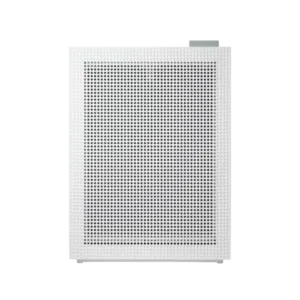
The Coway Airmega 150 pairs a washable pre-filter and an activated carbon stage with a True HEPA filter, covering spaces up to 55 m², such as bedrooms and home offices. It easily handles dust, fine allergens, and common household odours, but it should not be treated as a standalone fix for heavy formaldehyde off-gassing from new cabinetry. Explore the full selection in the air purifiers category.
What Air Quality Testing Shows and What It Doesn’t
Consumer indoor air quality monitors are helpful diagnostic tools, provided you understand their limitations. A reading gives you a single data point under specific, transient conditions—not an absolute safety clearance.
Testing protocols dictate the numbers. The ISO 16000-2 standard sets out the sampling protocol for formaldehyde in naturally ventilated spaces: ventilate thoroughly for 15 minutes, seal all windows and doors for at least 8 hours (preferably overnight), and then collect a 30-minute air sample inside the closed room. Because the WHO guideline is defined as a 30-minute average, this procedure provides a standardized, comparable baseline. Keep in mind, however, that this test intentionally simulates a worst-case scenario rather than day-to-day living conditions.
Readings shift with the weather. Ambient temperature, relative humidity, and air exchange rates all shift chemical concentrations throughout the day. To track meaningful trends, always test under identical conditions at the same time of day. Testing standards also suggest evaluating your ventilation efficiency: after your initial reading, air out the space for 5 minutes, seal the room, and take a follow-up measurement one hour later to see how fast chemical levels rebound.
TVOC is an indicator, not a health assessment. The German Federal Environment Agency (UBA) notes that TVOC values alone cannot determine health risks. A high TVOC reading could be triggered by completely harmless ethanol vapour from a cleaning spray, or by a complex mixture of harmful respiratory irritants. On top of that, raw TVOC numbers vary widely depending on the sensor brand, detection technology, and factory calibration.
Consumer sensors carry wide margins of error. Most affordable home monitors rely on metal-oxide semiconductor (MOS) sensors. These sensors react broadly to dozens of airborne compounds simultaneously and fluctuate when ambient temperature and humidity shift. Comparative studies have shown that budget sensors often correlate more closely with changes in humidity than with actual VOC concentrations. Treat them as directional tools for spotting broad trends, not laboratory-grade instruments.
The best practical approach is to use a portable monitor to check whether chemical levels are steadily declining over weeks, or to verify how effectively your ventilation lowers concentrations. If you experience persistent respiratory problems, recurring headaches, or need defensible documentation for a builder dispute, arrange for an accredited laboratory test or a professional indoor air quality assessment.
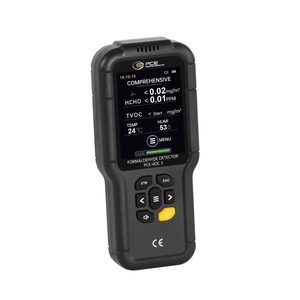
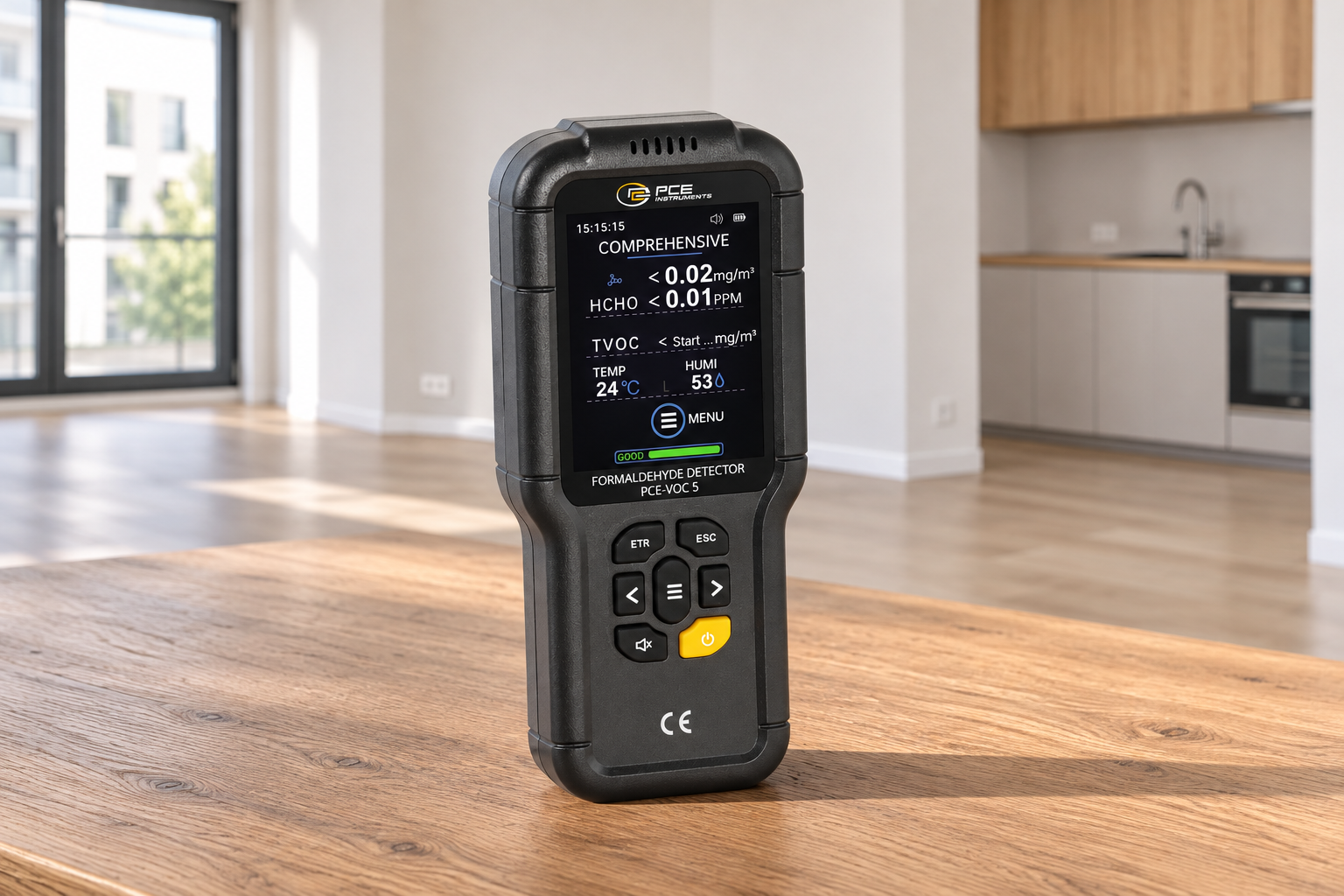
The PCE-VOC 5 tracks formaldehyde, TVOC, temperature, and relative humidity, complete with data logging and an adjustable audible alarm. It is an excellent tool for tracking indoor trends and checking ventilation habits, though it does not replace certified laboratory air sampling.
Move-In Action Plan
- Before building or renovating: Ask contractors and suppliers for verified low-emission certifications (EMICODE EC1, M1, EU Ecolabel, or Blue Angel).
- During construction: Isolate the work area from living spaces, exhaust dust outside under negative pressure, and stick to wet-sanding methods.
- After finishing: Run mechanical ventilation or exhaust fans at maximum capacity for at least 72 hours. Hold off on moving in soft furnishings, rugs, or mattresses until wet coats of paint, varnish, and adhesive have fully cured.
- During the first few months: Run your mechanical ventilation continuously. Avoid overheating living spaces, as higher temperatures accelerate the release of chemicals from building materials.
- Monitor: Take periodic readings under repeatable, controlled conditions to verify that pollutant levels are trending downward over time.
- Filter: Run an air purifier equipped with a dense activated carbon bed and a True HEPA filter as a supporting safeguard, not as a replacement for outdoor air.
If you or your family experience unexplained headaches, fatigue, or eye and airway irritation that clears up whenever you leave the house, speak with a doctor and arrange for professional indoor air testing. While these symptoms can stem from several causes, new building materials should always be evaluated.
Keeping the air clean in a new home comes down to three essentials: controlling the materials you bring inside, maintaining steady fresh air exchange, and interpreting air quality data realistically. Air purifiers provide valuable backup, but source control and continuous ventilation do the real heavy lifting.
Frequently Asked Questions
The most intense off-gassing occurs during the first few weeks and months, after which emissions taper off. Research shows that reaching a permanent, stable baseline can take two years or longer. Keep in mind that the absence of a chemical smell does not mean emissions have stopped; keep your ventilation running continuously even after that “new home” smell has faded.
No. HEPA filters are engineered solely to capture airborne particulates, not chemical gases. Trapping VOCs requires an adsorbent material like activated carbon, though standard carbon has a very limited capacity for formaldehyde. Your most reliable defenses remain strict source control and high ventilation rates, with purifiers acting as a secondary line of support.
Not on its own. Sensor readings fluctuate based on temperature, relative humidity, cross-sensitivities, and sensor quality. The WHO guideline of 0.1 mg/m³ for formaldehyde is based on a 30-minute average under specific testing conditions. Use consumer monitors to identify trends and assess ventilation effectiveness, and commission an accredited laboratory test if you need legally binding or health-diagnostic results.