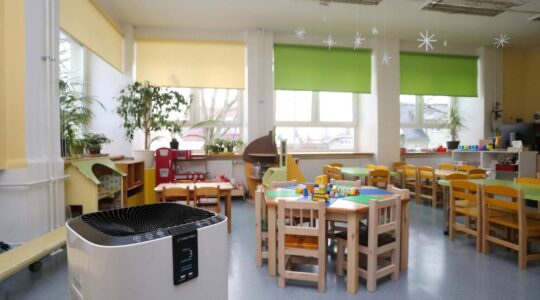



Tori Municipality is purchasing 278 air purifiers from Pro Air OÜ for use in schools and kindergartens.
The coronavirus spreads through the air, so good ventilation is essential to prevent infection, but renovating school buildings could take years. In the meantime, Jarek Kurnitski, a professor at Tallinn University of Technology, believes it makes sense to install air purifiers in classrooms.
“It’s not a very complicated device. Essentially, it consists of a fan and a mechanical filter. Devices like this have been around for a long time, and there are many different models,” Kurnitski told ERR. “Several studies have been conducted in classrooms showing that if two air purifiers with sufficient capacity are installed, they can indeed remove the virus from the air. They are relatively inexpensive, but of course, every device comes with maintenance costs.”
Kurnitski added that purchasing in bulk makes the cleaners cheaper. Furthermore, technical requirements could be agreed upon to find equipment with sufficient capacity that does not make too much noise.
According to Kurnitski, local governments have not purchased such cleaning machines. However, Tallinn Real School, for example, has started using them.
Through a public procurement process, Tori Municipality is acquiring 278 air purifiers, which have been selected based on the size of the rooms.
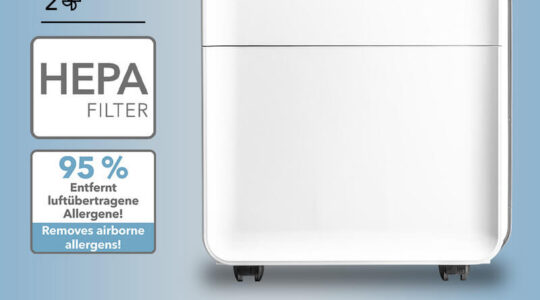
Air purifiers remove 99.97% of PM 2.5 particles from the air, which is important for reducing the viral load in classrooms and daycare centers.
At the end of the year, the Ministry of Education and Research allocated 2.6 million euros to local governments specifically for improving ventilation systems in general education schools and purchasing CO2 sensors and air purifiers.
Riisaar added that sensors are more important than air purifiers for first understanding where the ventilation is and how poor it is.
The ministry does not know how many air purifiers local governments have purchased. Riisaar merely stated that the Tallinn City Government has discussed organizing a procurement process. The ministry itself has no plans to purchase air purifiers.
“We are not going to start using these devices. Two devices are needed for each classroom. For classrooms with natural ventilation, that amounts to at least 3,500 or 7,000 devices. Each school or school operator must decide for itself whether it wants this device and whether it will actually use it, taking into account, for example, electricity costs, filter costs, and potential noise levels,” explained Riisaar.
We find it difficult to understand Mr. Riisaar’s claim that CO2 sensors are more important than air purifiers.
It is clear that a certain amount of air exchange is necessary to reduce the viral load. Rooms without ventilation definitely need air purifiers to reduce the viral load. It is difficult to understand the officials’ rigid mindset, which certainly will not resolve the situation in schools and daycare centers.