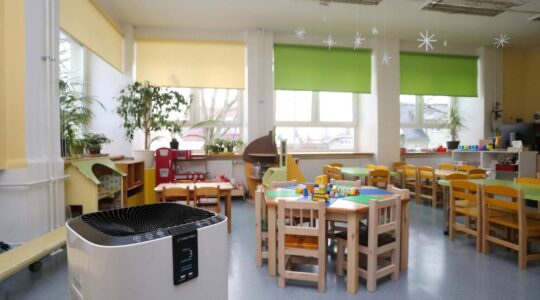


Improving indoor air quality is a key component of maintaining a healthy learning and working environment. An Italian study shows that high-performance ventilation and air purification systems, such as the Troteci TAC high-performance air purifiers, can reduce COVID-19 infections in schools by more than 80 percent. The solution is simple—students and teachers aren’t stuck at home, but can participate in in-person learning.
High indoor air quality reduces the risk of infection
A study led by the David Hume Foundation think tank compared cases of COVID-19 infection in 10,441 classrooms in the Marche region of Italy. Data was collected between September 13, 2021, and January 31, 2022. In 316 classrooms equipped with technical ventilation or air purification systems, there were significantly fewer cases of infection than in classrooms without such systems. The reduction in infections correlated with the performance of the equipment used. With higher air exchange rates, the number of infections decreased significantly.
Air exchange rate is extremely important
When using equipment that ensures up to 2.4 air changes per hour, the number of infections decreased by 40 percent. By comparison, with 4 air changes per hour, infections fell by 66.8 percent, and with 6 air changes per hour, they fell by as much as 82 percent.
Most Italian schools lack ventilation or air purification systems. Instead, teachers are encouraged to ventilate by opening windows when weather conditions and temperatures permit. This measure has long been established, but it has no significant effect.
If the most effective systems were installed, “we could reduce the rate from 250 cases per 100,000 students (the alert level set by the Ministry of Education) to 50 cases per 100,000 students ,” the Hume Foundation and the Marche Regional Government stated in a joint press release.
“The study has shown that the impact of ventilation and air purification systems on reducing the viral load in the air is very strong and statistically significant,” said Professor Luca Ricolfi, president of the Hume Foundation and professor of data analysis at the University of Turin. , explaining the study’s findings. “The higher the air exchange rate, the greater the reduction in infections.” Therefore, it is not enough to simply place any device in a room. The device’s performance must definitely be matched to the size of the room. This is all the more important given that the risk of infection is 30–40 percent higher in larger rooms than in smaller ones.
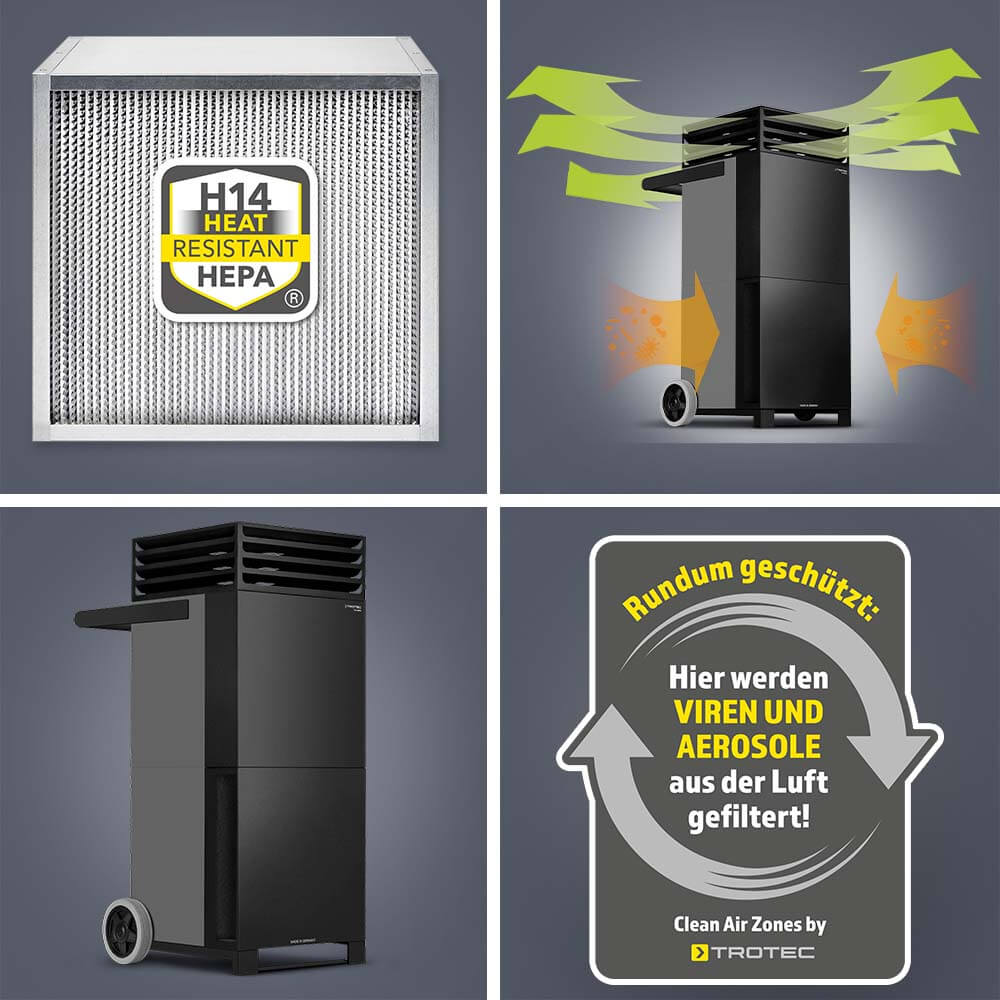
The results of the Italian study are not surprising. As early as August 2020, research conducted and led by Prof. Christian J. Kähler at the University of the Federal Armed Forces in Munich showed that Troteci high-performance air purifier TAC V+ “can reduce aerosol concentrations in rooms with an area of 80 m² by half within 6–15 minutes, thanks to its high airflow volume and F7 + H14 filter combination, depending on the airflow rate. In rooms measuring 20 m², a 50% reduction is achieved in 3–5 minutes, depending on the airflow rate. Therefore, room air purifiers can easily maintain low aerosol concentrations in small and medium-sized rooms.
Just as safe and clean as the air outside
The difference is noticeable: indoor air purified by a TAC high-tech air purifier corresponds to the natural viral load of outdoor air and often even surpasses it in terms of purity. High concentrations of fine dust or pollen, which are particularly burdensome for sensitive individuals suffering from allergic or chronic respiratory diseases when outdoors, and the high-performance TAC air purifier filters out up to 99.995 percent of these particles from indoor air.