

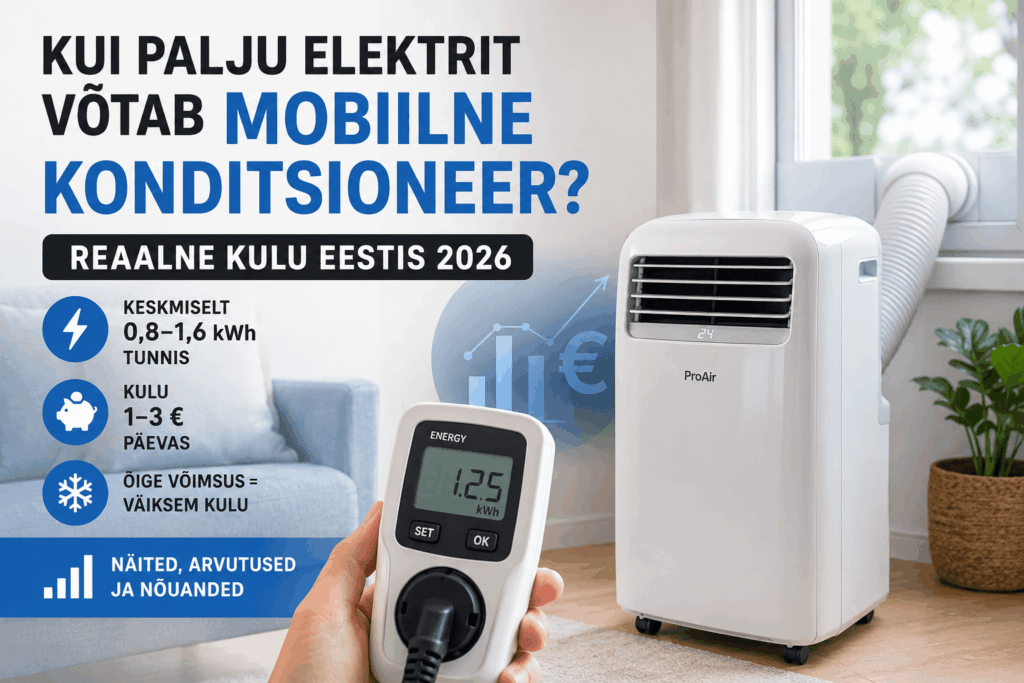
One of the most common questions in the summer is: Does a portable air conditioner use a lot of electricity?
In fact, electricity consumption depends more on the size of the room, its insulation, and the suitability of the unit than on the unit’s power rating alone.
Many people mistakenly believe that a lower-capacity air conditioner always saves more electricity. In reality, the opposite may be true—a unit that is too weak runs constantly at full capacity and takes much longer to cool the room.
How much energy is needed to cool a room?
Cooling each room requires a certain amount of energy.
For example, if a room has:
- a large window facing the sun,
- poor insulation,
- a lot of electronics or people,
This generates more heat, and the air conditioner has to work harder.
This means that:
- A less powerful air conditioner runs longer,
- A more powerful air conditioner cools faster,
- but the final energy consumption may be almost the same.
For example:
- A 2-kW air conditioner can run for 10 hours,
- A 4-kW air conditioner can do the same job in 5 hours.
All in all, the electricity costs may end up being very similar, since the amount of energy required for cooling remains the same.
How much power does a portable air conditioner actually use?
An average portable air conditioner uses:
- about 0.8–1.6 kWh of electricity per hour,
- depending on the model and load.
An example based on electricity prices in Estonia in 2026
If the total price of electricity is approximately 0.18 €/kWh:
| Air Conditioner Capacity | Electricity cost per hour | 8 hours per day |
|---|---|---|
| The smaller 2.6 kW model | ~0.9 kWh | ~1.30 € |
| Average 3.5 kW model | ~1.2 kWh | ~1.73 € |
| The more powerful 5 kW model | ~1.6 kWh | ~2.30 € |
The actual cost depends on:
- the outside temperature,
- the size of the room,
- the number of windows,
- insulation,
- from the desired temperature.
Does a larger air conditioner use more electricity?
Not always.
If the air conditioner isn’t powerful enough:
- the compressor runs continuously,
- the temperature does not drop fast enough,
- the device uses more power,
- The noise level may be higher.
A properly sized unit reaches the desired temperature more quickly and then operates at a lower load.
Why does an inverter air conditioner save electricity?
Mobile air conditioners with inverter technology automatically adjust their output.
This means:
- fewer starts,
- a more stable temperature,
- lower energy consumption,
- quieter operation.
A typical air conditioner often works on the following principle:
- full power → pause → full power.
An inverter reduces this fluctuation and can result in significant electricity savings.
How can I reduce my air conditioner’s electricity costs?
What helps the most is:
- use a window seal,
- Keep windows and doors closed,
- avoid direct sunlight,
- Choose a device with the right power rating.
For example, a window seal can significantly reduce heat transfer and improve cooling efficiency.
Summary
A portable air conditioner doesn’t have to be expensive to use if you choose a unit that’s right for the room.
It is important to understand:
- A certain amount of energy is required to cool a room,
- A device that’s too weak simply takes longer to work,
- A larger and more efficient air conditioner can do the same job in less time.
What matters most is not just the device’s power, but:
- proper sizing,
- good installation,
- and the room’s heat load.
FAQ – Electricity Costs for Portable Air Conditioners
Does a portable air conditioner use a lot of electricity?
On average, no. With normal use, the cost is often between 1 and 3 euros per day, depending on the device’s power consumption and how long it is used.
Does a smaller air conditioner save electricity?
Not always. If the device is too weak, it has to run much longer.
Is an inverter-based portable air conditioner more energy-efficient?
Yes. The inverter adjusts the power output as needed and reduces electricity costs.
Do window seals help save electricity?
Yes. The window seal reduces the backflow of hot air and improves cooling efficiency.
How big of an air conditioner should I choose?
It depends on:
- the area of the room,
- the height of the ceiling,
- from the windows,
- sun exposure,
- and insulation.
A unit that is too weak may not cool the room sufficiently.