

Kuma tee 4, Peetri, Estonia
Mon–Fri 9:00 a.m.–5:00 p.m.

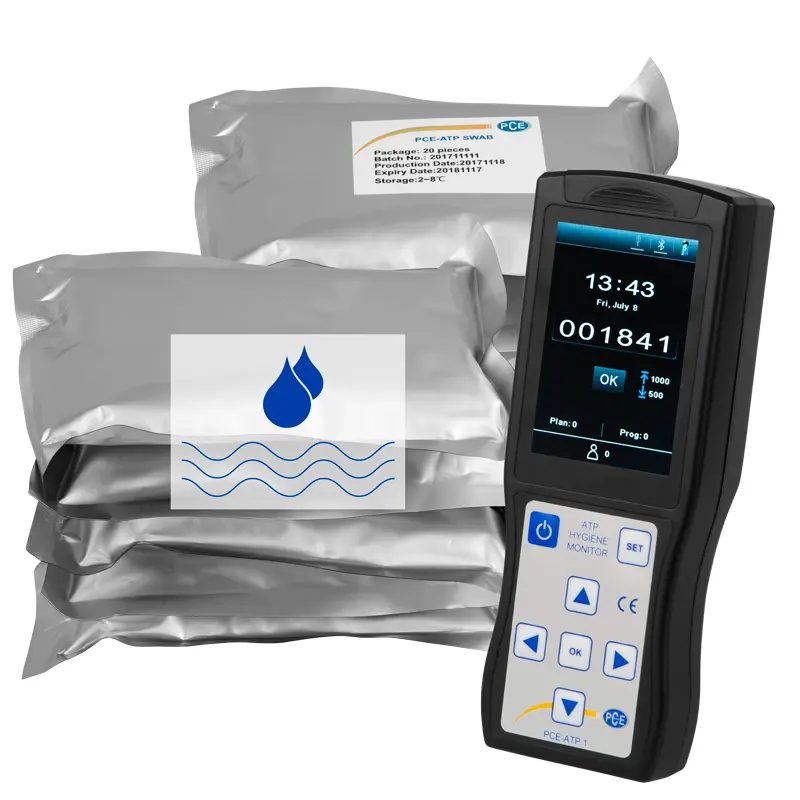
PCE-ATP 1 KIT3 Luminometer for Surfaces and Water

PCE-ATP 1 KIT3 Luminometer for Surfaces and Water

Calibration of the PCE-ATP 1 ATP Tester/Luminometer
During internal calibration or adjustment, the luminometer is tested using special program sequences and reset to zero. Two calibration options are available: a detailed calibration that takes 60 seconds and a quick calibration that takes only 15 seconds. To obtain more stable and accurate test results, the ATP tester should be started with the detailed calibration.

If necessary, a new calibration can also be initiated through the device menu while the device is in operation. To do this, remove the ATP test tube from the measurement chamber and close the measurement chamber flap. Whenever the luminometer has been operating for more than 30 minutes or the ambient temperature has changed by more than 5 degrees Celsius, a new calibration will begin automatically.

  • In stock
2 362 price including km
Free shipping For orders over €250
14-Day Return Policy Worry-Free Right to Purchase
Safe Payment

PCE-ATP 1 KIT3 Luminometer for Surfaces and Water

Luminometer / Rapid hygiene testing / Easy sample collection / USB and Bluetooth printer connectivity / Self-calibration upon startup

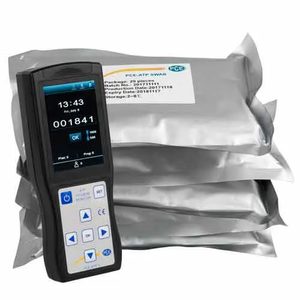
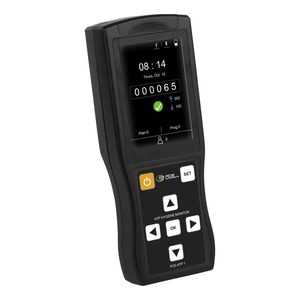
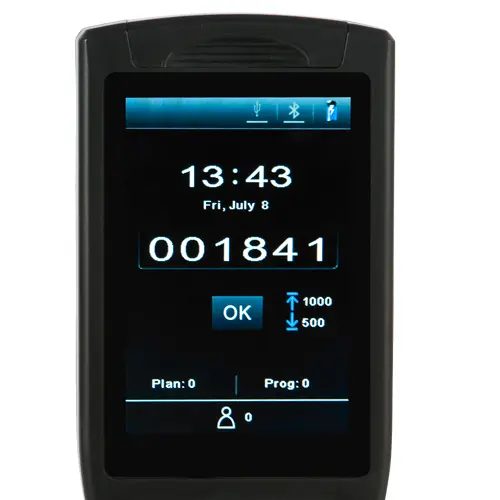
The luminometer, which comes with 200 test strips, is used for quick and easy testing of the cleanliness of surfaces and water. The luminometer displays the measurement result on a large LCD screen in just 10 seconds. Up to 10,000 sets of measurement data, along with the time and date, can be stored in the luminometer’s internal memory.

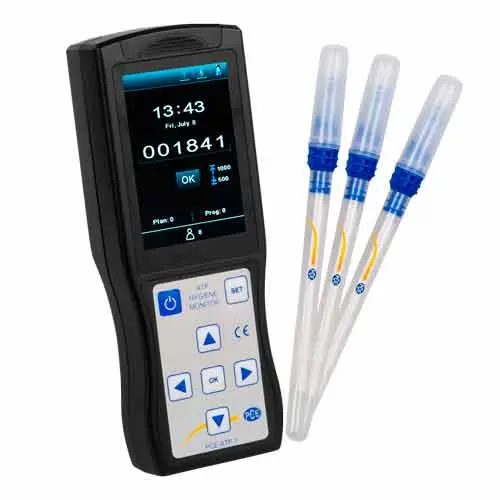
The luminometer, together with the associated PCE-ATP Surface Swab Pen, allows for the rapid detection of food or microbiological residues on all surfaces that come into contact with the product, serving as a test of the effectiveness of cleaning and disinfection measures. Quantitative determination of intracellular and extracellular adenosine triphosphate (ATP) is performed using a portable luminometer.

Data measured by the luminometer can be saved and processed further after the measurement. The luminometer is used for hygiene inspections in pharmacies, in the medical field, in the food service industry, at wholesalers, and elsewhere.

Measurements with the luminometer are performed using specially available ATP test tubes. A sample is taken from the surface using the swab provided in the tube. The swab is then pushed all the way into the tube so that it comes into contact with the reaction solution and the actual reagent. Gently shaking the tube causes the reaction solution to collect in the tube’s reaction chamber. The entire test tube is then inserted into the measurement chamber of the ATP test meter. The measurement is then started. After 10 seconds, the measurement result is displayed on the luminometer’s screen in RLU (relative Light Units).

A luminometer can be used in various industries. Thus, a luminometer enables full control and documentation in the food industry. This can include checking cleanliness in a large kitchen or processing food in large industrial facilities. The luminometer helps implement the HACCP concept.

In addition to its use in the food industry, cleaning companies can also use the hygiene tester to verify the effectiveness of their cleaning services. The ATP tester’s memory records the time of the measurement, along with the date and time. Furthermore, different users can be added to distinguish between measurement data.

In addition, the ATP Testing Meter is used in the healthcare sector. Anywhere where the cleanest surfaces and sterility are required, the luminometer can be used to quickly check for cleanliness.

Advantages

– Implementation of the HACCP concept
– Lightweight and fast measurement
– Data transfer to evaluation software
– Memory for 10,000 measured values
– Automatic self-calibration
– USB and Bluetooth printer interface
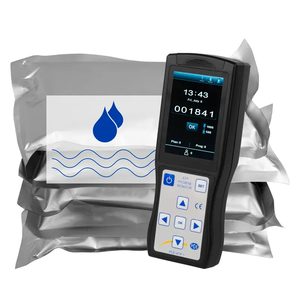
Includes 100 test tubes (swabs) for surfacesincluding 100 test tubes (swabs) for water

Specifications

Identification Methods

Analog Integration Using Photodiodes

Data Output

RLU (relative light unit)

Background Interference

± 5 RLU

Measuring Width

0 … 999,999 RLU

Measurement period

10 seconds

Screen

3.5-inch graphic LCD

Interface

USB
Bluetooth

Storage

256 users
10,000 entries

Self-Diagnosis

Automatic cleanliness test before each use

Environmental Conditions

5 … 40 °C / 41 … 104 °F, 20 … 80% relative humidity

Storage Conditions

-10 … 40 °C / 14 … 104 °F, max. 60% relative humidity

Power Supply

3.7 V / 2300 mAh lithium-ion battery

Battery Life Operating time: 10 hours Standby time: 600 hours

Dimensions

189 x 70 x 35 mm / 7.4 x 2.8 x 1.4 inches

Weight

approx. 280 g / < 1 pound

Scope of Delivery

1 x PCE-ATP 1 KIT3 Luminometer
1 x 3.7 V / 2300 mAh lithium-ion battery
1 x USB cable
1 x USB charger
1 x wrist strap
1 x computer software
1 x test tubes or swabs (100 pcs) (for surfaces)
1 x test tubes or swabs (100 pcs) (for water)

To purchase an ATP tester / luminometer


The ATP tester/luminometer is easy to use, and its instant results allow you to assess the situation right on the spot. The device can detect food residues on tables or other surfaces and, if present, indicates whether cleaning is necessary before production begins. The same applies to water and other liquids. The ATP tester can also be used in pipes or water tanks.

Since a large number of disinfectants and cleaning agents are used on a daily basis, it is reasonable to ask whether the results are still accurate when measured on surfaces where these products have been used. One advantage of ATP meters is that, due to their design and operating principle, the impact of disinfectants and cleaning agents on them is minimal.

This is measured in RLU (relative light units). These units represent the intensity of light emitted by the sample. During the measurement, the device detects the photons emitted as a result of the reaction between ATP molecules and the reagents contained in the strip. The result is directly related to the ATP value. A high reading therefore indicates a high ATP level.

It is important to note that there are no uniform, fixed limit values that apply to all food categories. Much also depends on how the food is prepared (frozen, boiled, fried), as well as the category of the end consumer (young children, the elderly, healthy or sick people, etc.).

Taking samples isn’t difficult—just be sure to follow the rules. The entire process takes only a few seconds. The device is compact and provides accurate measurement results. Luminometers vary depending on their intended use, but the measurement principle remains the same: a clean device is used to take a sample from a surface, object, or liquid, and the measured value is displayed immediately.

Regardless of where it is used — in food production, healthcare facilities, offices, or at home — the luminometer is always a great help in assessing sanitary and hygienic conditions and the effectiveness of cleaning measures. This makes the ATP tester a valuable tool for effective monitoring, helping to prevent errors and problems and maintain healthy environmental conditions. ATP testers help you produce high-quality goods with a reasonable shelf life.

ATP Tester / Luminometer PCE-ATP 1
ATP Tester Functionality
The abbreviation ATP stands for the chemical compound adenosine triphosphate, which is produced by living plant and animal cells, as well as bacteria, molds, and yeasts. Once cells are dead, they no longer produce ATP. When adenosine triphosphate binds to luciferin and luciferase, a reaction occurs that emits light. This phenomenon, known as bioluminescence, can be used to detect ATP in a sample.

The intensity of the reaction light depends on the amount of ATP present. Based on the measured values of light intensity, it is therefore possible to draw conclusions about the amounts of ATP derived from organisms in the samples studied. Measurements are made in RLU (Relative Light Units), a unit specifically defined for this type of light measurement. The more adenosine triphosphate in the sample that reacts, the higher the RLU value.

Since ATP measurement is performed using light, ATP testers are also called photometers or luminometers because they utilize luminescence. A luminometer does not require a light source for measurement. The sample itself is illuminated by an excited chemical reaction. A complete measurement with the PCE-ATP 1, including sample collection, takes only about 20 seconds. This can be done directly on-site without time-consuming preparations.

DIN 10124, “ATP Measurement—Basis for Determining Hygiene Status Using Bioluminescence,” describes the application of the ATP testing method in hygiene inspections. More specifically, it describes both the procedure and the capabilities and limitations of the method.

The PCE-ATP 1 works with test kits that cannot distinguish the source of ATP. It detects ATP not only from various microorganisms but also from food residues and other organic materials. In many cases, differentiation is not necessary to monitor the effectiveness of cleaning measures. In general, the informative value of the total ATP content is sufficient even for rapid tests of biological contamination in drinking water, process water, or distilled water.

When evaluating RLU values, however, regardless of the test kit used, one must always take into account that, depending on the type of substance or organism, the amount of ATP per cell or individual varies. For example, a yeast cell may contain 100 times more ATP than a bacterium. In addition, certain substances present in the sample material may attenuate the luminescent reaction and thereby affect the result.

Calibration of the PCE-ATP 1 ATP Tester/Luminometer
During internal calibration or adjustment, the luminometer is tested using special program sequences and reset to zero. Two calibration options are available: a detailed calibration that takes 60 seconds and a quick calibration that takes only 15 seconds. To obtain more stable and accurate test results, the ATP tester should be started with the detailed calibration.

If necessary, a new calibration can also be initiated through the device menu while the device is in operation. To do this, remove the ATP test tube from the measurement chamber and close the measurement chamber flap. Whenever the luminometer has been operating for more than 30 minutes or the ambient temperature has changed by more than 5 degrees Celsius, a new calibration will begin automatically.

For the SWABS surfaces and SWABS liquids in the “
” ATP method, consumables are required in addition to the tester. Test tubes (puffers) are available for the PCE-ATP 1 luminometer, which are tailored to the test method and the measuring instrument. The test tubes contain a test stick for collecting the sample and the appropriate amount of reagents to initiate the biochemical reaction.
Test kits are also referred to as swabs, and because they provide rapid results, they are called rapid swabs or rapid test swabs. Swabs for surfaces differ from those for liquids. Both types of swabs have a limited shelf life due to the reagents they contain. If stored at the recommended temperature of 2–8 degrees Celsius, the shelf life is 12 months.

Before use, the test tube should be allowed to acclimate to the ambient temperature of the test environment. This usually takes about 10–20 minutes. When collecting a sample with the test swab, ensure that the procedures previously defined for comparison are followed. After collecting the sample, place the swab back into the test tube. There, the sample comes into contact with the reagents contained in the tube. To evaluate the reaction of the sample, the entire test tube is then inserted into the measurement chamber of the ATP tester/luminometer.

FAQ