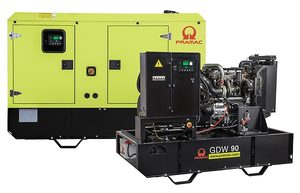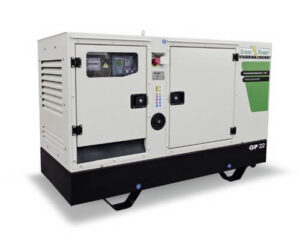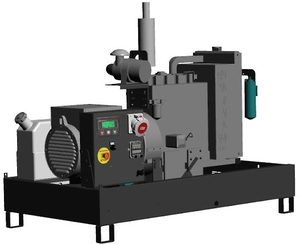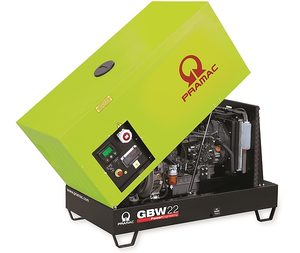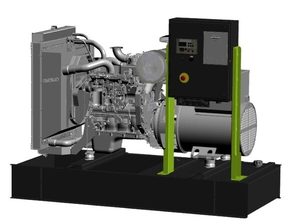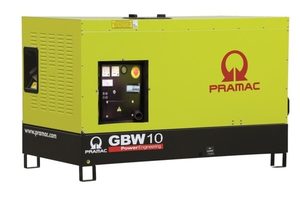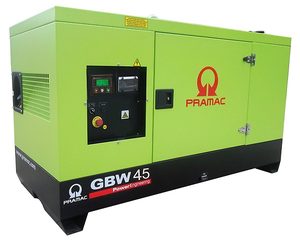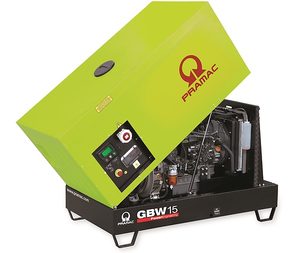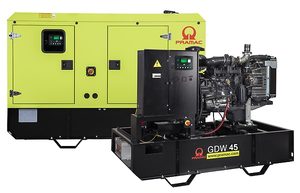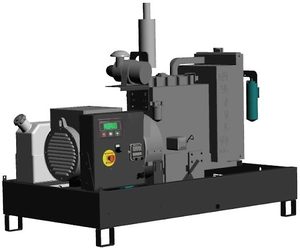


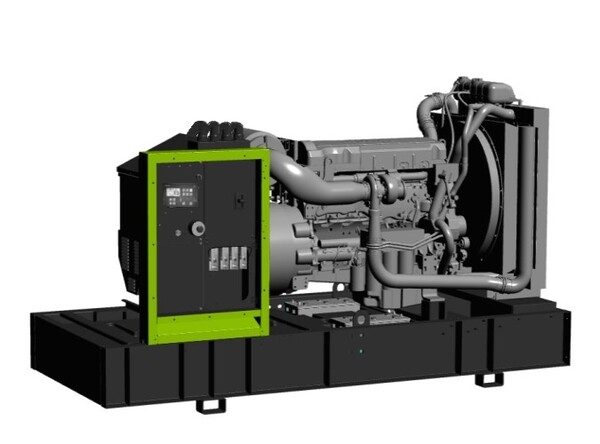



Model: Pramac GSW-250P
Main features
- Frequency: 50 Hz
- Voltage: 400 V
- Power factor: 0.8 cos ϕ
- Phase: 3
Power rating
- Emergency standby power esp: 250.00 kVA
- Emergency standby power esp: 200.00 kW
- Prime power prp: 233.08 kVA
- Prime power prp: 186.46 kW
Rating definitions
Ratings definition (ISO-8528-1)
ESP
- Emergency Standby Power:
It is the maximum power available during a variable electrical power sequence, under the stated operating conditions, for which a generating set is capable of delivering in the event of a utility power outage or under test conditions for up to 200 h of operation per year with the maintenance intervals and procedures being carried out as prescribed by the manufacturers. The permissible average power output over 24 h of operation shall not exceed 70 % of the ESP.
PRP
- Prime Power: It is defined as being the maximum power which a generating set is capable of delivering continuously whilst supplying a variable electrical load when operated for an unlimited number of hours per year under the agreed operating conditions with the maintenance intervals and procedures being carried out as prescribed by the manufacturer. The permissible average power output over 24 h of operation shall not exceed 70 % of the prime power.
Engine specifications
- Engine brand: Perkins
- Model: 1506A-E88TAG2
- [50hz] exhaust emission level: Non Emission Certified
- Engine cooling system: Water
- Nr. of cylinder and disposition: 6 in line
- Displacement: 8800 cm³
- Aspiration: Turbocharged
- Speed governor: Electronic
- Prime gross power prp: 213 kW
- Maximum gross power ltp esp: 236 kW
- Oil capacity: 41 l
- Lube oil consumption prp (max): 0.1 %
- Coolant capacity: 29.6 l
- Fuel: Diesel
- Specific fuel consumption 75% prp: 194.4 g/kWh
- Specific fuel consumption prp: 197 g/kWh
- Starting system: Electric
- Starting engine capability: 5.3 kW
- Electric circuit: 24 V
Engine equipment
- Starting system: Air inlet system • Mounted air filter and turbocharger Cooling system • Air-to-air charge cooler incorporated in radiator • Mounted belt driven pusher fan • Radiator with all guards and pipes • Thermostatically controlled with belt driven, circulating pump and belt-drive fan Fuel system • Electronic governing to ISO 8528-5 with stand-alone isochronous and load-sharing capabilities • Fuel filter, fuel transfer pump, fuel priming pump • HEUI fuel system with full authority electronic control • Spin on primary, secondary and water filter separator Oil system • Full flow spin-on filters • Oil pump gear driven • Wet full aluminium sump with filler and dipstick
Alternator specifications
- Alternator: Mecc Alte
- Model: ECO38 1M4 C
- Voltage: 400 V
- Frequency: 50 Hz
- Power factor: 0.8 cos ϕ
- Poles: 4
- Type: Brushless
- Voltage tolerance: 1.5 %
- Efficiency @ 75% load: 93.3 %
- Class: H
- Ip protection: 21
Alternator equipment
- Mechanical structure: Mechanical structure
- Mechanical structure text: Robust mechanical structure which permits easy access to the connections and components during routine maintenance check-ups.
- Voltage regulator: Voltage regulator
- Voltage regulator text: Voltage regulation with DSR. The digital DSR controls the range of voltage, avoiding any possible trouble that can be made by unskilled personnel. The voltage accuracy is ±1% in static condition with any power factor and with speed variation between 5% and +30% with reference to the rated speed.
- Windings / excitation system: Windings / Excitation system
- Windings / excitation system text: Generator stator is wound to 2/3 pitch. This eliminates triplen (3rd, 9th, 15th …) harmonics on the voltage waveform and is found to be the optimum design for trouble-free supply of non-linear loads. The 2/3 pitch design avoids excessive neutral currents sometimes seen with higher winding pitches. MAUX (Standard): The MAUX MeccAlte Auxiliary Winding is a separate winding within the main stators that feeds the regulator. This winding enables to take an overload of 300% forced current (short circuit maintenance) for 20 seconds. This is ideal for motor starting requirements.
- Insulation / impregnation: Insulation / Impregnation
- Insulation / impregnation text: Insulation is of class H standard. Impregnation is made with premium tropicalised epoxy resins by dipping and dripping. High voltage parts are impregnated by vacuum, so the insulation level is always very good. In the high-power models, the stator windings undergo a second insulation process. Grey protection is applied on the main and exciter stator to give enhanced protection.
- Reference standards: Reference standards
- Reference standards text: Alternator manufactured according to , and complies with , the most common specification such as CEI 2-3, IEC 34-1, EN 60034-1, VDE 0530, BS 4999-5000, CAN/CSA-C22.2 No14-95-No100-95.
Genset equipment
BASE FRAME MADE OF WELDED STEEL PROFILE, COMPLETE WITH:
• Steel base frame with support legs
• Anti-vibration mountings properly sized
• Grounding point to connect all metal parts of the generating set
PROTECTIONS: • Moving and rotating parts protection against accidental contacts. ENGINE COMPLETE WITH: • Battery • Liquids (no fuel)
EXHAUST (Standard): • Industrial silencer (loose)
- Baseframe: FUEL TANK WITH THE FOLLOWING COMPONENT: • Filler neck • Air breather (ventilation pipe) • Minimum fuel level sensor
Dimensional data
- Length: 3300 (L) mm
- Width: 1400 (W) mm
- Height: 1844 (H) mm
- Dry weight: 2377 kg
- Fuel tank capacity: 620 l
- Fuel tank material: Metal
Autonomy
- Fuel consumption @ 75% prp: 37.58 l/h
- Fuel consumption @ 100% prp: 49.95 l/h
- Running time 75% prp: 16.50 h
- Running time 100% prp: 12.41 h
Installation data
- Total air flow: 416.38 m³/min
- Exhaust gas flow: 34.4 m³/min
- Exhaust gas temperature: 475 °C
Electrical data
- Max current: 360.85 A
- Circuit breaker: 400 A
Control panel availability
- Automatic control panel: ACP
Acp – automatic control panel
Mounted on the genset, complete with digital control unit for monitoring, control and protection of the generating set protected through door with lockable door
INSTRUMENTATION DIGITAL
• Generating set voltage (3 phases)• Mains voltage
• Generating set frequency
• Generating set current (3 phases)
• Battery voltage• Power (kVA – kW – kVAr)• Power factor Cos• Hours-counter
• Engine speed r.p.m.• Fuel level (%)• Engine temperature (depending on model)
- Second part of the text: COMMANDS AND OTHERS • Four operation modes: OFF – Manual starting – Automatic starting – Automatic test • Pushbutton for forcing Mains contactor or Genset contactor • Push-buttons: start/stop, fault reset, up/down/page/enter selection • Remote starting availability • Acoustic alarm • Automatic battery charger • USB, RS232 and RS485 Communication ports • Settable PIN for protection level
- Third part of the text: PROTECTIONS WITH ALARM • Engine protections: low fuel level, low oil pressure, high engine temperature • Genset protections: under/over voltage, overload, under/over frequency, starting failure, under/over battery voltage PROTECTIONS WITH SHUTDOWN • Engine protections: low fuel level, low oil pressure, high engine temperature • Genset protection: under/over voltage, overload, under/over battery voltage, battery charge failure
- Part4: OTHERS PROTECTIONS • Emergency stop button
Out put panel acp
- Plinth row for connection from acp to lts panel.: √
- Power cables connection to circuit breaker.: √
Optional features:
- To be ordered with equipment (when necessary): :
Engine supplements
- Coolant pre-heating system: PHS