

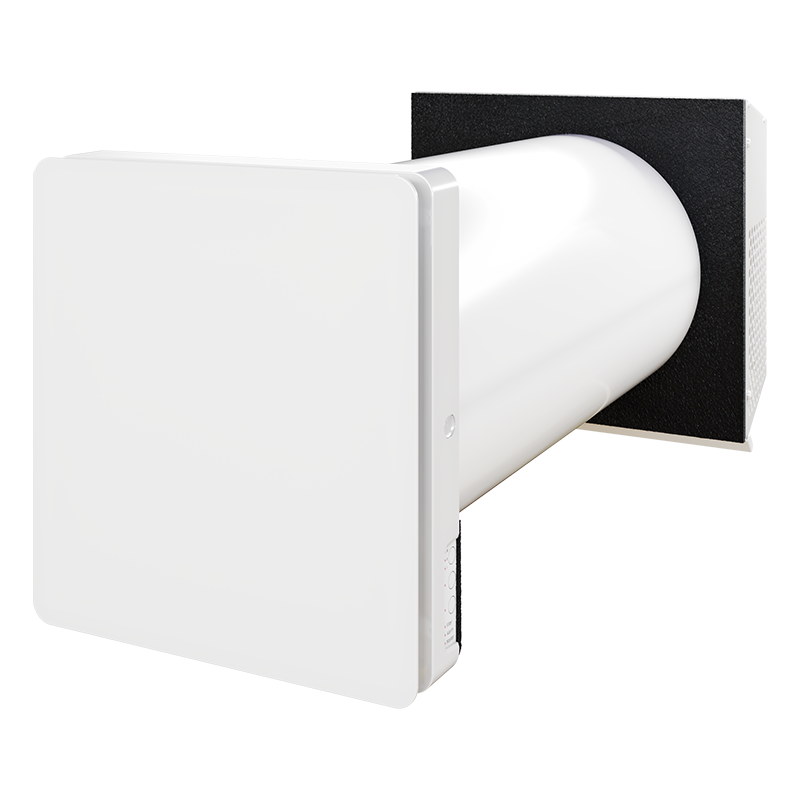



Blauberg AirOne ERV – local ventilation unit with moisture recovery
Blauberg AirOne ERV is a local heat recovery ventilation unit that, in addition to heat energy, also helps to retain some of the humidity in the indoor air in the building.
ERV stands for Energy Recovery Ventilation . Unlike conventional HRV ventilation, the ERV version uses a moisture-transferring or enthalpy heat exchanger .
Blauberg uses enthalpy heat exchangers in its ERV ventilation units specifically for heat and energy recovery.
AirOne ERV is particularly well suited for new and renovated energy-efficient homes , where winter indoor air tends to become too dry due to intensive ventilation.
What makes ERV ventilation special?
A standard HRV system primarily recovers heat.
An ERV recovers heat and some of the moisture.
In winter, the warm exhaust air contains moisture. Instead of venting all the moisture out of the building along with the exhaust air, the enthalpy heat exchanger allows some of that moisture to be transferred to the incoming air.
This helps reduce excessive drying of the indoor air.
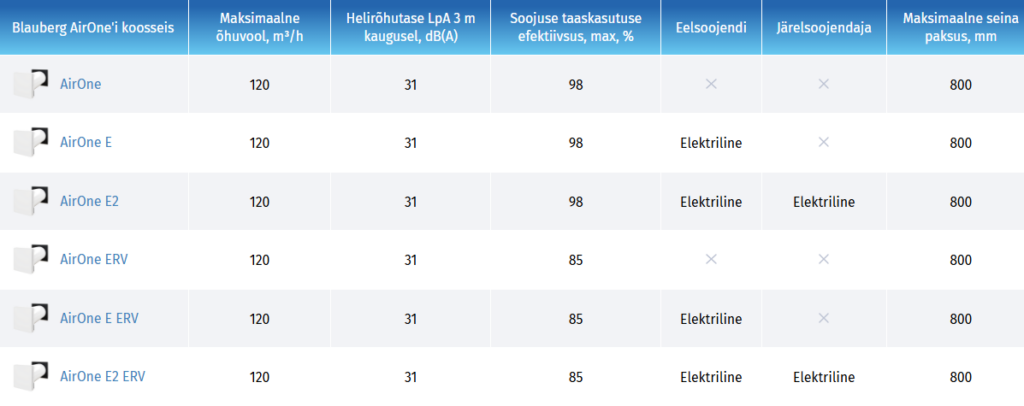
Why choose AirOne ERV?
AirOne ERV is a good solution if you want to:
- ventilation with heat recovery;
- maintain better indoor humidity in the winter;
- reduce the problem of excessively dry indoor air;
- remove CO₂ from the room;
- provide a constant supply of fresh outdoor air;
- ventilate a bedroom or living room;
- improve air exchange without a central duct system.
ERV is not an air humidifier
There is an important difference here.
The AirOne ERV does not generate moisture on its own, nor does it function as a humidifier.
The device helps retain some of the moisture that is already generated inside the building through human respiration, bathing, cooking, and other daily activities.
Therefore, the actual relative humidity of the indoor air always depends on the building, the ventilation rate, the outdoor temperature, and the number of occupants.
Particularly suitable for energy-efficient single-family homes
New and renovated homes are often very airtight.
This is good from an energy efficiency standpoint, but it means that air exchange in the building must be controlled through ventilation.
In winter, intensive ventilation can make the indoor air very dry. An ERV helps reduce this effect because not all moisture is removed from the building with the exhaust air.
AirOne ERV for the bedroom
The bedroom is one of the rooms where local ERV ventilation can be particularly beneficial.
During the night, people produce both CO₂ and moisture. Ventilation must remove the CO₂, but in very cold weather, high air exchange rates can simultaneously make the room too dry.
An ERV heat exchanger helps to better balance these two needs.
When should you choose an ERV instead of an HRV?
Choose the AirOne ERV if:
- the indoor air becomes too dry in the winter;
- you have a new or very airtight house;
- your home has adequate ventilation, but the relative humidity drops too low in the winter;
- you want to retain some of the indoor humidity in addition to heat;
- you want the most comfortable year-round ventilation possible in your bedroom.
However, if excessive humidity and condensation are a constant problem in your home, an HRV may be a more suitable solution.
AirOne ERV Technology
| Feature | AirOne ERV |
|---|---|
| Ventilation Type | supply + exhaust |
| Heat Recovery | Yes |
| Moisture Recovery | Yes, partial |
| Heat Exchanger | ERV / enthalpy |
| Fresh Air Inlet | Yes |
| CO₂ Removal | Yes |
| Maintaining Humidity in Winter | Yes |
| On-site installation | Yes |
| Plumbing for the entire house is required | No |
| Suitable for an energy-efficient home | Yes |
| Suitable for an apartment | Yes |
| Perfect for the bedroom | Yes |
HRV vs. ERV – What’s the Difference?
To put it simply:
AirOne HRV → recovers heat.
AirOne ERV → recovers heat + some moisture.
This does not mean that the ERV recirculates exhaust air back into the room. Supply and exhaust air remain separate air streams, and energy transfer occurs via a heat exchanger.
The official specifications for Blauberg’s other ERV units confirm the use of an enthalpy heat exchanger for energy recovery.
Frequently Asked Questions
What is ERV ventilation?
ERV, or Energy Recovery Ventilation, is a ventilation system that allows not only heat but also some moisture to be transferred.
Does an ERV increase humidity in the home?
An ERV does not introduce new moisture. It reduces the amount of moisture lost through ventilation.
Does the AirOne ERV remove CO₂?
Yes. The ERV’s humidity recovery does not hinder air exchange—stale indoor air is removed and replaced with fresh outdoor air.
Is ERV suitable for Estonia’s climate?
ERV is particularly interesting in Estonia’s cold winters, because the absolute humidity of the outdoor air is very low at that time, and intensive ventilation can significantly dry out the indoor air.
Is the ERV suitable for a bedroom?
Yes. A bedroom is a good place to use it, because it’s important to both remove CO₂ and maintain comfortable indoor air quality throughout the night.